About Phyllomedusa trinitatis Mertens, 1926
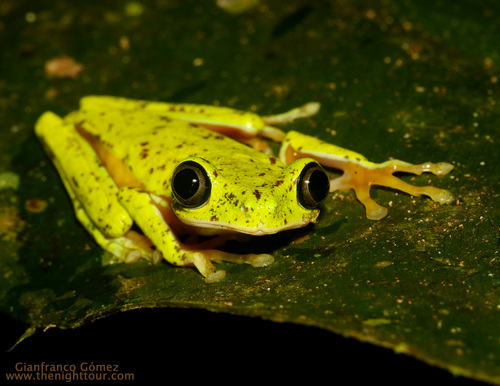
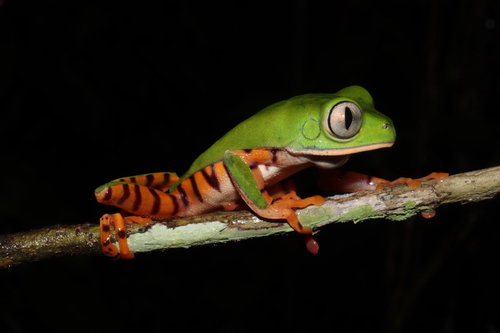
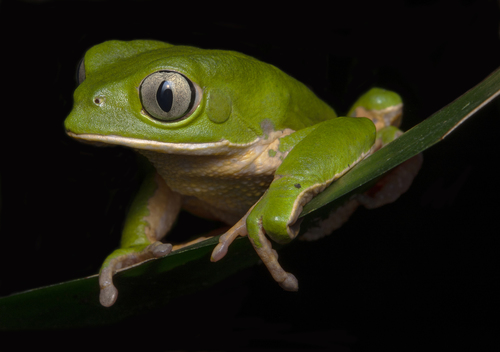
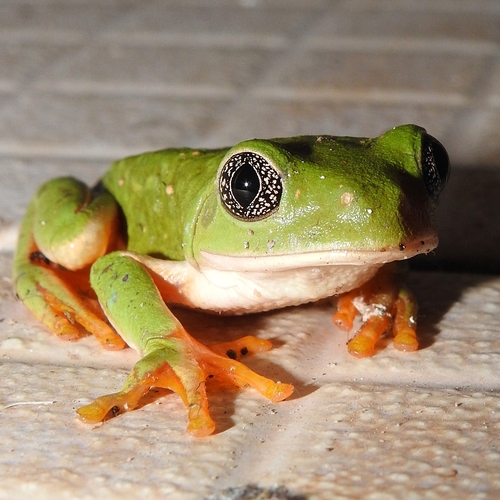
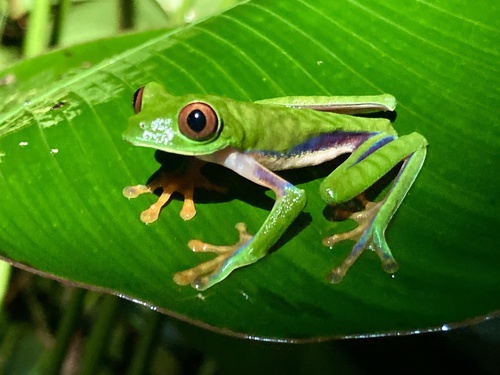
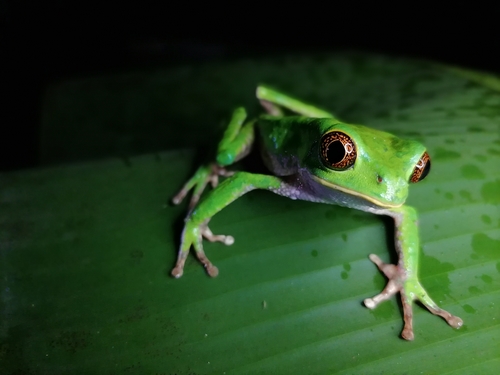
Phyllomedusa trinitatis Mertens, 1926 is an arboreal frog species. It has a bright green body, black and yellow eyes, and a brown chin and chest. The skin on its back is finely granular, dotted with small tubercles. Adults measure between 50 and 80 millimeters in length, and the species displays sexual dimorphism: females are roughly 1.5 times larger than males. Unlike some related frogs, its limbs have no webbing. Instead, both the forelimbs and hindlimbs have adhesive toe pads and opposable first fingers and toes, a trait shared with other Hylidae tree frogs that makes this species well-adapted for climbing and moving through treetop habitats. Males of this species lack external vocal slits.
This species is distributed across northern Venezuela, where it occurs in the states of Distrito Federal, Sucre, Vargas, Miranda, Aragua, Carabobo, Yaracuy, Monagas, northern Bolívar, Guárico, and eastern Falcón. It is also found on the island of Trinidad, in multiple areas including Arima, Chatham, and the Northern Range.
In its life cycle, P. trinitatis mates and lays eggs on vegetation above water. The eggs are wrapped in jelly capsules or plugs produced by the mother. These jelly plugs consist of 96 to 97% water and 2 to 3% dry matter, are made up of mucopolysaccharides, and have a dense core surrounded by an outer matrix. The jelly plug and capsule prevent water from being absorbed into the eggs during rainfall, because unlike the eggs of most other amphibians, P. trinitatis eggs cannot survive if submerged in water. It is currently unknown how embryos of this species survive potential hypoxic conditions. Like other frogs in the genus Phyllomedusa, P. trinitatis encloses its eggs inside folded leaves. This leaf case protects the entire egg clutch and shields the jelly plug from rain. P. trinitatis shows no demonstrated preference for any specific leaf type or number when building its egg nest. When one embryo hatches, this event triggers other eggs in the clutch to hatch as well. After hatching, the tadpoles fall down into the water below.