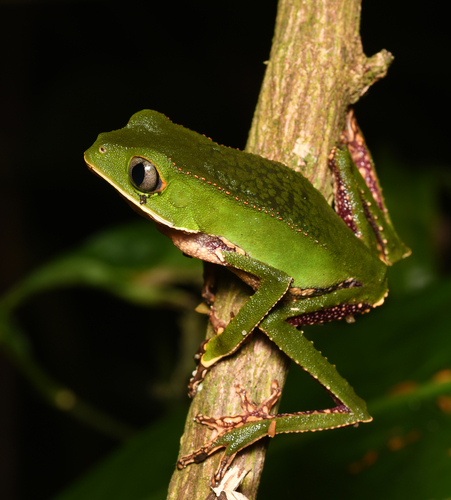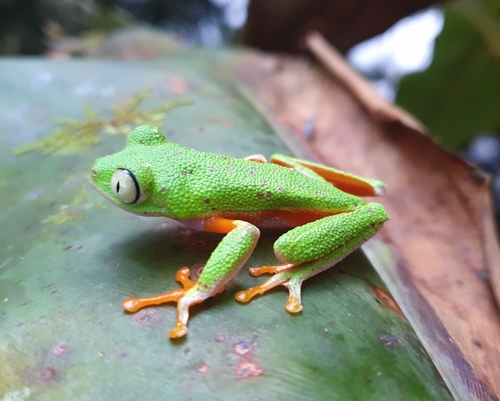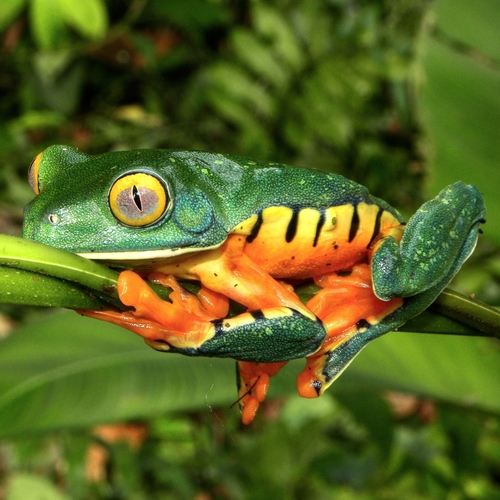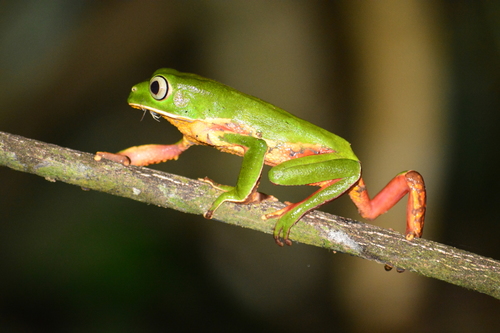
About Phyllomedusa sauvagii Boulenger, 1882
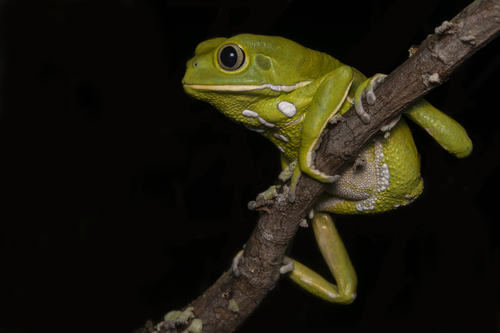
Phyllomedusa sauvagii, commonly known as the waxy monkey leaf frog or waxy monkey tree frog, is a species of frog in the subfamily Phyllomedusinae. It is native to South America, where it occurs in Argentina, Bolivia, Paraguay and Brazil. This species is arboreal, and lives in the vegetation of the Gran Chaco. The waxy monkey leaf frog breeds during the rainy season, which typically lasts from October until March. Mating does not happen continuously throughout this season, and only occurs during or shortly after periods of heavy rainfall. Males find a shrub or tree near or in a body of water, where they begin to vocalize to attract females. This species is an amplectant mater, meaning breeding pairs create their egg nest together. The pair moves toward their oviposition site, usually on a leaf overhanging a body of water, where the male assists the female in laying her eggs while fertilizing them at the same time. The choice of oviposition site is critical to the reproductive success of waxy monkey leaf frogs. Their eggs are highly permeable to water and will desiccate if laid in nesting sites that are too arid or exposed to the sun. The nest must also be on a leaf on a branch suspended over fresh water, so hatching tadpoles can drop into the water below. Waxy monkey leaf frogs non-randomly select sites, favoring larger leaves and locations that overhang standing water. To prevent egg desiccation, females lay empty gelatinous capsules that surround the fertile eggs. These capsules provide extra fluid for embryo development and help keep the eggs from drying out. They also have adherent properties that help breeding pairs wrap their nests in the leaf the eggs are laid on. Waxy monkey leaf frogs may also use more than one leaf to effectively wrap their clutch of eggs. Compared to most anurans, the eggs of this species are large and yolk-heavy. Embryo development usually lasts between six and nine days, after which embryos hatch spontaneously and drop into the water. Upon hatching, tadpoles have relatively large external gills, an oral disc with multiple lines of keratinized teeth, and a tail that makes up about two thirds of their total body length. Waxy monkey leaf frog embryos may exceed twenty millimeters in length when they hatch.