About Phylloglossum drummondii Kunze
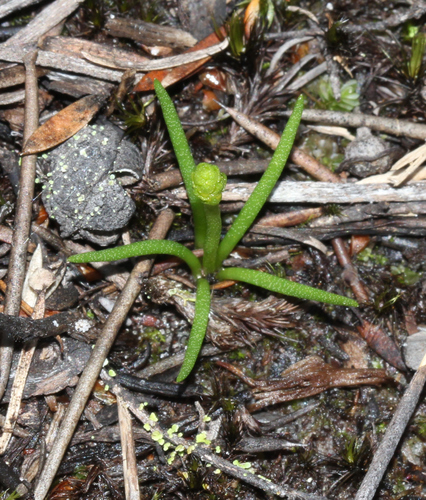
Phylloglossum is a genus of small plants in the clubmoss family Lycopodiaceae. Species in this genus grow from an underground bulb-like root, producing a rosette of slender leaves 2 to 5 cm long, and superficially resemble tiny grass plants. The genus produces a single central stem that grows up to 5 cm tall, with a spore-producing cone at its tip. In the past, Phylloglossum was variously classified either in Lycopodiaceae or placed in its own separate family, Phylloglossaceae. Recent genetic evidence shows that the genus is most closely related to Huperzia, and forms a sister clade to Phlegmariurus, a genus that was formerly included within Huperzia. Both morphological traits and molecular data from the rbcL gene support the close relationship between Phylloglossum and Huperzia. Similarities in spore morphology, sporangial epidermis morphology, phytochemistry, and chromosome number also confirm that these two genera are closely related. One morphological trait that complicated this classification is the presence of a perenniating tuber in Phylloglossum. This trait previously led scientists to incorrectly group Phylloglossum closer to the genus Lycopodiella. The underground perenniating tuber of Phylloglossum is unique within Lycopodiaceae: it is a reduced stem system that has developed into a distinct new organ. This tuber is an adaptation to dry seasons, allowing the plant to survive through dormancy. Phylloglossum drummondii, the only species in the genus, is the only fully deciduous member of Lycopodiaceae that regenerates from tubers. Its gametophyte is non-photosynthetic when young, obtaining nutrients from mycorrhiza, and develops a photosynthetic crown as it matures. The single species in the genus is Phylloglossum drummondii, commonly called pygmy clubmoss. It is native to Australia, where it occurs in southwestern Western Australia, southern South Australia, Victoria, and Tasmania, and to New Zealand, where it occurs on the North Island.