About Phyllodoce caerulea (L.) Bab.
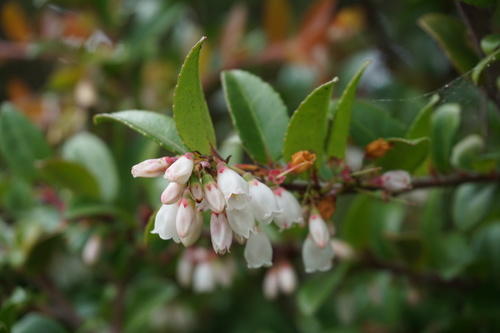
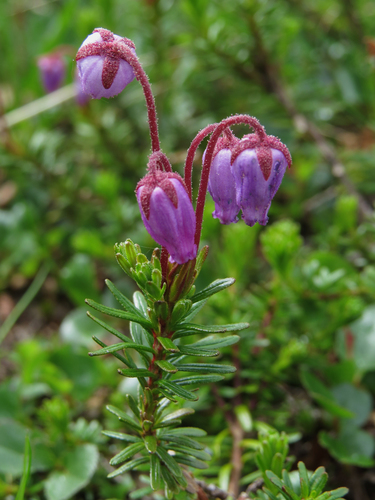
Phyllodoce caerulea (L.) Bab. is a low evergreen shrub, that usually reaches 5–15 centimetres (2–6 in) in height, and may exceptionally grow to 25 cm (10 in). Its alternately arranged leaves measure 4–10 mm (0.16–0.39 in) long and 1.7–3.6 mm (0.07–0.14 in) wide, and grow from 1-millimetre (0.04 in) long petioles. Its flowers grow in clusters of 2–6, with each individual flower measuring 8–12 mm (0.3–0.5 in) long. The corolla is made of five fused petals that start purple and fade to bluish pink. Five sepals surround the corolla, which in turn surrounds 8–10 free stamens and a superior ovary that produces nectar at its base. Phyllodoce caerulea has a patchy circumboreal distribution, with distribution gaps between 110° W and 155° W, and between 70° E and 125° E. In Europe, it occurs from Iceland to the Kanin Peninsula. Its distribution within Iceland is also disjunct, covering the area around Eyjafjörður and one site near Desjarmyri. In the British Isles, it is restricted to a small number of sites in the Scottish Highlands. It was first discovered growing around a spring at 740 metres (2,430 ft) altitude on the slopes of the Sow of Atholl, and has since been found at a handful of sites in the Ben Alder forest. It has been a protected species in the UK since 1975, under the Conservation of Wild Creatures and Wild Plants Act. While there are reports of this species growing in the Swiss Alps, no herbarium specimens exist to confirm this occurrence. The species has never been observed on the Faroe Islands, Jan Mayen, Bjørnøya, Svalbard or Franz Josef Land. In Asia, it grows in the Ural Mountains, around Lake Baikal, and in the Mongolian Khangai and Kentii mountains, but does not grow across most of central Siberia. It is also found on Hokkaido, Sakhalin, the Kamchatka Peninsula, and in Beringia. In North America, it occurs in coastal Alaska, the Northwest Territories, Quebec and Labrador, as well as in scattered locations in the Gaspé Peninsula, and the White Mountains of New Hampshire and Vermont. It is widespread and common across Greenland. Its absence from Yukon has been described as "surprising".