About Phyllocladus toatoa Molloy
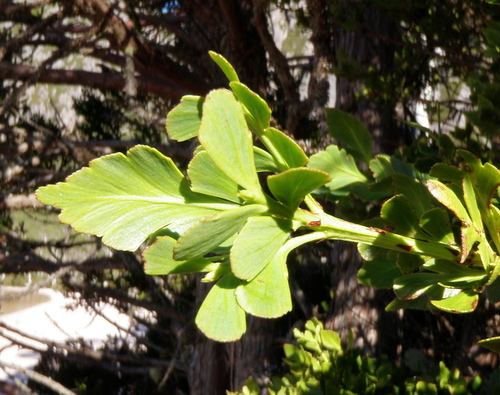
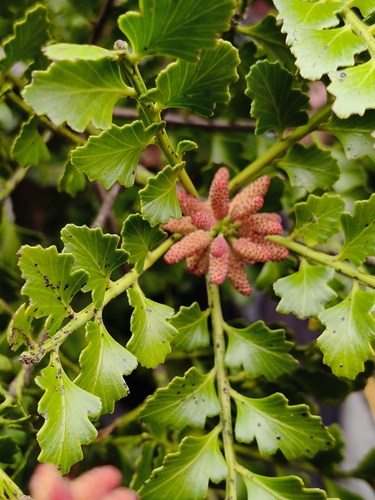
Phyllocladus toatoa is a small tree that can be either dioecious or monoecious, with a growth form that is either conical or bushy. On average, mature individuals reach 15 m (49 ft) in height and 60 cm (24 in) in trunk diameter. Its outer bark color ranges from dark brown to silvery-brown. This species can be distinguished from other members of the genus Phyllocladus by its whorled pinnate phylloclades, which have diamond-shaped segments. Cladodes attach to whorled branches. P. toatoa flowers from October to December, and fruits develop between January and March. The fruit is a nut held within a cup-shaped envelope. Each fruit contains 3 to 4 square-shaped seeds that measure 3 mm across, which turn black when mature. Mature cultivated plants of this species flower every year. This is a wind-pollinated species; male cones produce large quantities of pollen. Mature seeds are expelled out of the cone onto the ground by the swelling of cone bracts. The species has a limited distribution, so many seeds fall to the ground directly under the female tree. The fact that this species can establish itself over large areas indicates that its seeds are dispersed by both wind and birds. P. toatoa is difficult to propagate and grows relatively slowly. This species is endemic to New Zealand, where it occurs only on the North Island. It grows in lowland and montane forests from the central North Island northwards. It tolerates infertile soils, so it can grow on exposed ridges, around bog margins, and on other poorly drained sites in New Zealand. Its preferred habitat is a temperate climate with well-drained, moist soil, where its roots receive partial shade and its foliage is exposed to sun. It is considered well protected and not threatened.