About Phyllocladus aspleniifolius (Labill.) Hook.f.
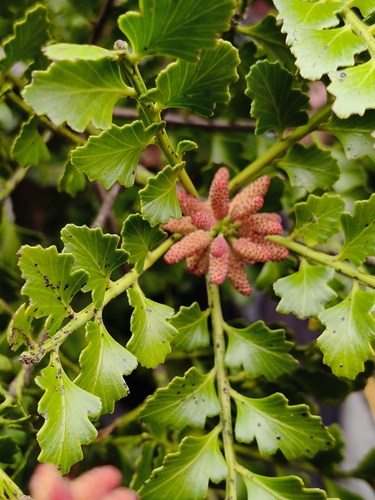
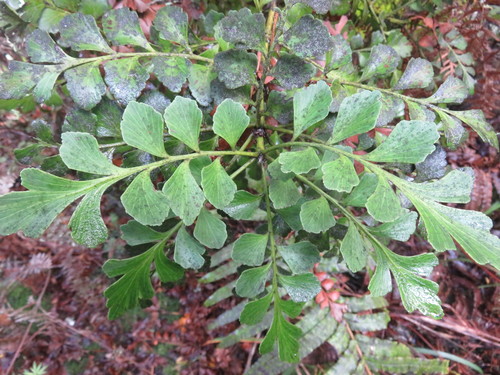
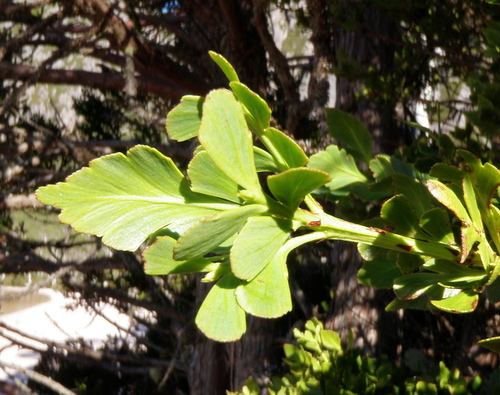
Phyllocladus aspleniifolius (Labill.) Hook.f. is a large, conical conifer in the family Podocarpaceae. It has an erect trunk with horizontal branches. True leaves only grow at the seedling stage, and are fine and needle-like. Mature leaves are reduced to tiny brown scales; photosynthetic function is instead carried out by cladodes that resemble green diamond-shaped leaves, similar to the leaves of a celery plant, which gives the species its common name "celery-top pine". These cladodes are thick and flattened, 3–8 cm long, and grow spirally on green stems. This species may bear male and female cones on the same tree or separate trees, and cone production occurs in summer. Male cones are cylindrical, 3–5 mm long, and grow in groups of 2 to 3 at the tips of side branches. Female cones form groups of 3 to 4 in short, stalked clusters at the axils or margins of the cladodes. Mature cones are distinctly fleshy pink to red, with a white aril that holds a hard, black, exposed seed. Phyllocladus aspleniifolius is endemic to Tasmania, and is the most widespread and abundant conifer in the state. It is most commonly found in wet sclerophyll forest and rainforest, from sea level up to 1200 m in western and southwestern Tasmania. It grows in all suitable habitat across Tasmania, with smaller populations also occurring in the north and east. At higher altitudes, it grows as a stunted shrub. It is a common component of cool temperate rainforest vegetation types in Tasmania. When it grows alongside other rainforest species such as Nothofagus cunninghamii, Atherosperma moschatum, and Eucryphia lucida, the vegetation is classified as rainforest. Phyllocladus aspleniifolius dominates rainforests on poorer soils, while Nothofagus cunninghamii dominates rainforests on more fertile soil types. The largest individuals of this species grow in wet sclerophyll forests with a Eucalyptus spp. canopy, and can reach up to 800 years old. It grows on acidic, well-drained soils derived from dolerite, granite or quartzite, and can also grow on boulder or scree slopes. Its habitat is high rainfall areas with no distinct drought periods. It is less shade tolerant than co-occurring rainforest species, and relies on a higher fire frequency to regenerate in these areas, regenerating freely in burnt forests. The wood of Phyllocladus aspleniifolius is highly valued by fine furniture makers and wooden boat builders. At middle altitudes in forests, the species grows into a medium-sized tree. The wood from large, well-formed trees is straight-grained, dense, and golden brown, similar in appearance to yew (Taxus) wood. It is classified as a high-value specialty species by the timber industry. The wood is hard and strong, with minimal shrinkage, good workability and bending properties, and high durability. Uses of the wood include railway sleepers, flooring, ship masts, furniture, and cabinet work. This species can be grown as an attractive container plant, but it is slow growing, and prefers cool, moist, acidic soil that requires constant moisture when grown in containers. As a result, it is rare in cultivation, and is limited to botanic gardens, arboreta, and a small number of private gardens. It has also been used in climate change research. Because Phyllocladus aspleniifolius grows across a wide range of sites and is sensitive to climate conditions, patterns of its ring width and wood density are used to study past climate.