About Phyllobates vittatus (Cope, 1893)
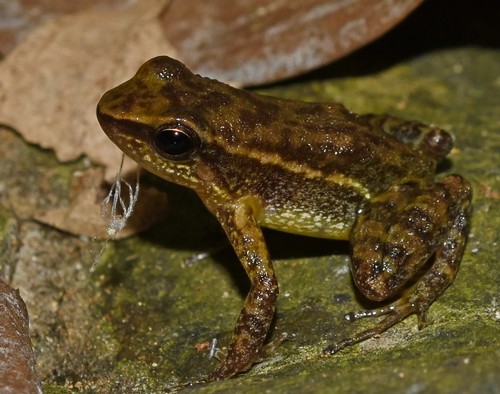
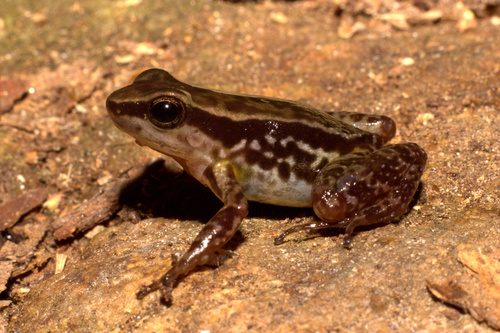
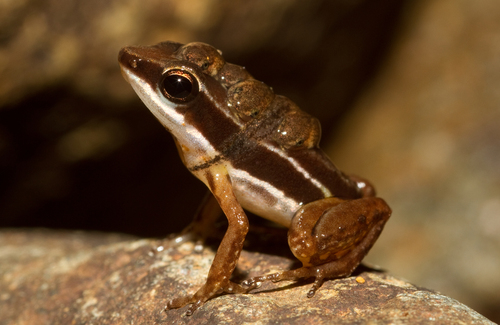
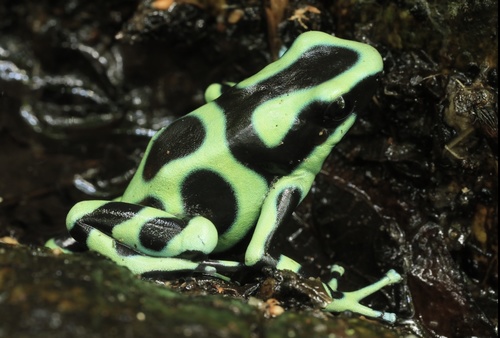
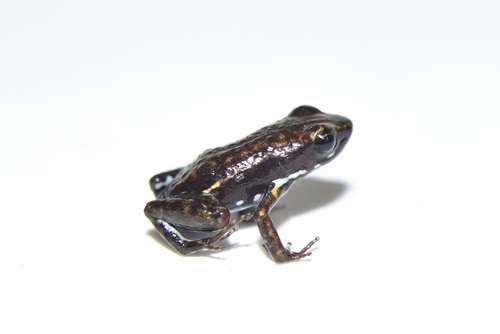
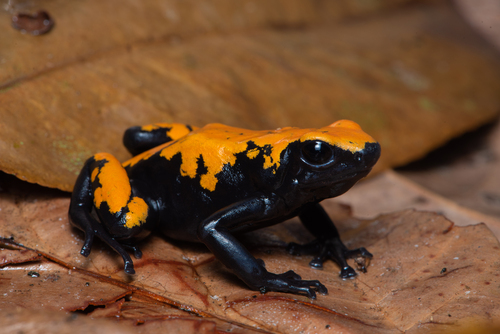
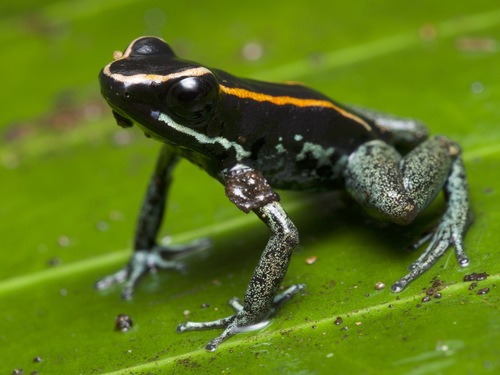
Phyllobates vittatus, commonly called the Golfodulcean poison frog, is a fairly large poison frog. Adult individuals reach a length of 3.5 cm, and females are typically larger than males. Compared to other species in the genus Phyllobates, these frogs have smoother bodies and almost perfectly sloping backs. Unlike related species P. bicolor and P. terribilis, their shoulder blades are usually not visible under the skin, which gives the frogs an appearance of being overweight. The frog's base body color is black, and it may look glittery due to chemical pigments in its skin. Its legs are mottled blue, and the sides often have a blue or green marble pattern. One of its most distinctive features, which gives the species its name, is two stripes running down its back. These stripes are most often fire orange, but may also be golden, yellow, or green, and extend from just above the cloaca all the way to the tip of the frog's nose.
During the breeding season, female P. vittatus lay eggs every one to two weeks, producing between 7 and 21 eggs per clutch. Females lay their eggs on leaves, and the eggs take between a few days and a week to hatch. Tadpoles are dark brown in color. Male frogs provide care for the eggs, using hydric brooding to prevent the eggs from dehydrating. After the eggs hatch, the male sits next to the empty egg capsules and stamps the ground with his feet. Over the course of around ten minutes, tadpoles climb onto his back. The male then carries the tadpoles to water, a journey that may take 1 to 2 days. He may transport them to a puddle, a pool of water trapped in a palm leaf, or a water-filled tree hole. Tadpoles complete metamorphosis into young frogs after approximately 45 days, and these young froglets reach sexual maturity after ten months.
Like all members of the genus Phyllobates, Golfodulcean poison frogs carry highly potent neurotoxic alkaloid poisons in their skin. The specific neurotoxin here is batrachotoxin. According to research published by Protti‐Sánchez et al. in 2019, P. vittatus and P. ligubris are sometimes considered non-toxic because they have low concentrations of this alkaloid. Even though it is only the fourth-most toxic species in its genus, the Golfodulcean poison frog is still a highly toxic animal. A sufficiently large dose of its poison causes severe pain, followed by tonic-clonic seizures and paralysis. The frog advertises its toxic nature to potential predators with its multicolored body. As it is comparatively large for a poison dart frog, it can store a large amount of poison in its skin. Captive P. vittatus do not have the toxin, which suggests the frogs do not produce the poison themselves, and instead acquire it from a species of insect or other small invertebrate that they eat in the wild. Scientists have not yet confirmed the source of batrachotoxin for any species in the genus Phyllobates, though toxic birds from New Guinea are thought to acquire batrachotoxin from small beetles of the family Melyridae.