About Phyllobates lugubris (Schmidt, 1857)
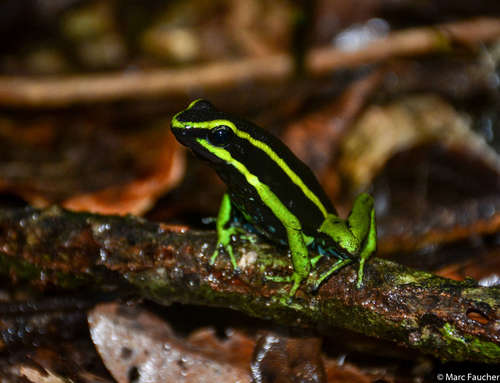
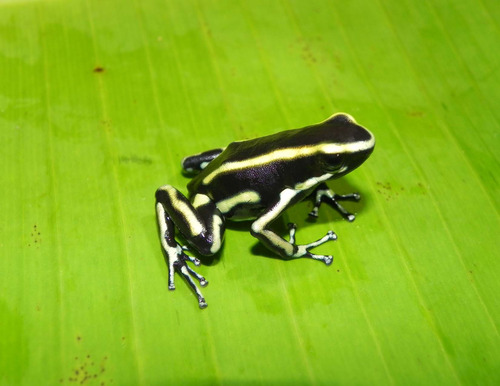
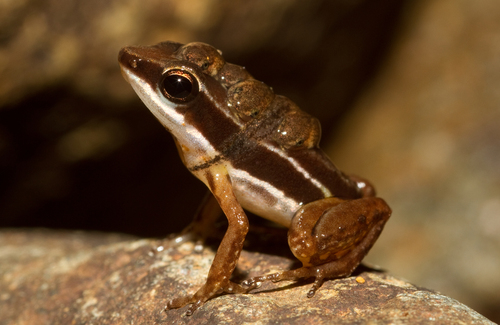
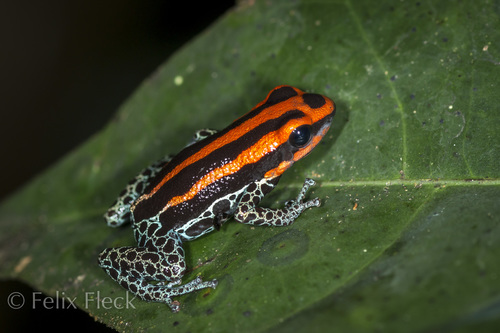
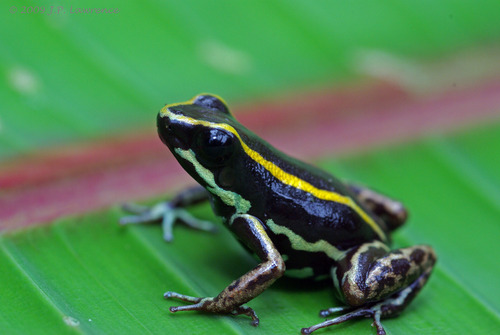
Adult Phyllobates lugubris males measure 18.5–21 mm (0.73–0.83 in) and females 21–24 mm (0.83–0.94 in) in snout–vent length. This species has maxillary teeth. The dorsum is black, marked by a pair of dorsolateral stripes that are typically pale yellow, gold, or orange; these stripes run along the sides of the dorsum from near the hindlimbs to the snout. Limbs are usually mottled with yellow to greenish yellow. Ventral surfaces are mottled with extensive black pigment, which often gives these surfaces an almost solid black appearance. Like other related species, P. lugubris is normally toxic, but some Central American populations are not known to be toxic. Phyllobates lugubris lives in humid lowland forests, and can also marginally occur in premontane forests, at elevations ranging from 10–601 m (33–1,972 ft) above sea level. It can also be found in secondary growth and plantations. This is a diurnal, terrestrial species, and adult frogs are often located near rocky sections of forest streams. Potential threats to the species include general habitat loss and pollution. Batrachochytrium dendrobatidis, the chytrid fungus, has been detected in P. lugubris museum specimens, but its effect on wild natural populations remains unknown. This species sometimes appears in the pet trade, and some illegal collection for this purpose occurs. It is listed under CITES Appendix II, and is found in several existing protected areas. For reproduction, a male P. lugubris first selects a concealed perch, such as a watery area surrounded by vegetation. He then calls to attract a female. The female lays eggs on dry leaf litter. The male cares for the eggs, protecting them from dehydration through hydric brooding. After eggs hatch, the male carries the tadpoles on his back to streams, where the tadpoles finish their development.