About Phyllidia ocellata Cuvier, 1804
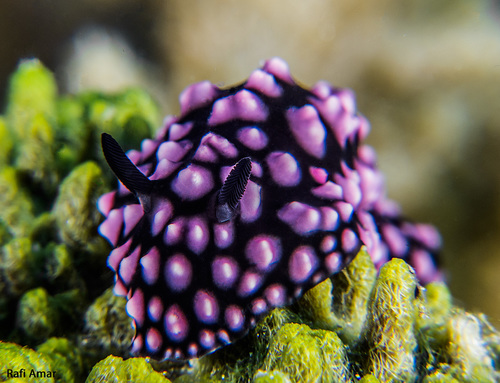
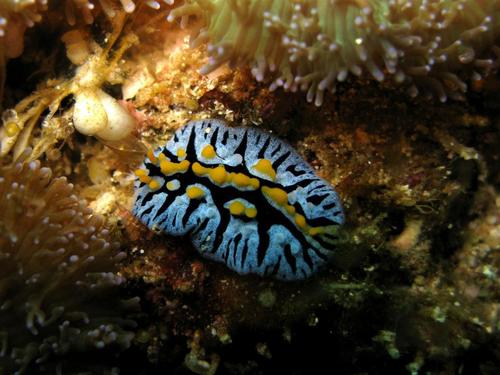
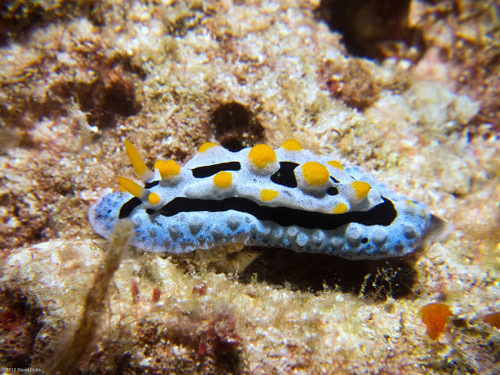
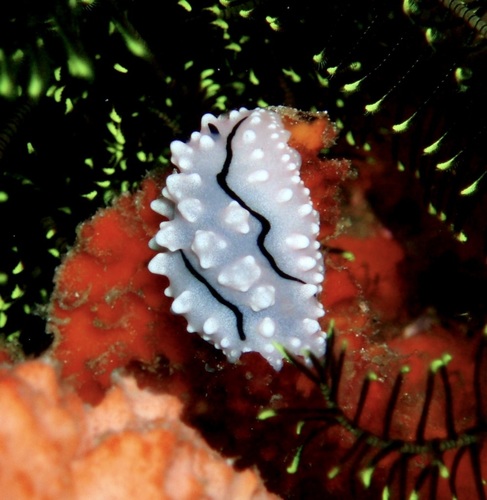
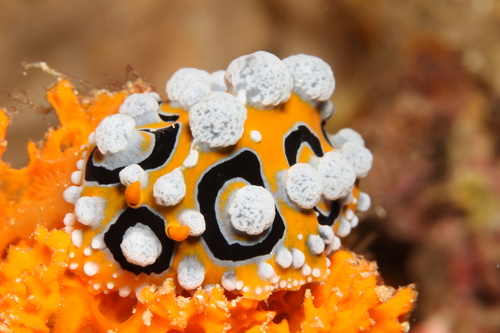
Phyllidia ocellata is a nudibranch that can reach a maximum length of 35 mm. Most researchers have historically confused this species with Phyllidia japonica, Phyllidia multituberculata, Phyllidia undula, and several other related species. Its dorsum is orange-brown, marked by large white or grey compound, stalked tubercles. These tubercles are arranged in a line running from between the rhinophores to the tail, while smaller, more scattered tubercles are found toward the mantle edge. Four black rings, each surrounding a tubercle, are positioned symmetrically across the middle region of the back. Larger individuals may have two additional black patches closer to the tail, or two extra tubercles each encircled by a black ring. A single tubercle located in front of the rhinophores is also surrounded by a black ring, and the rhinophores themselves are orange-yellow. This species is likely restricted to the central Indo-West Pacific Ocean. It is common in Indonesia, and its range extends from Malaysia to the Solomon Islands. Like many other nudibranchs, Phyllidia ocellata feeds on sponges.