About Phyllanthus acidus (L.) Skeels
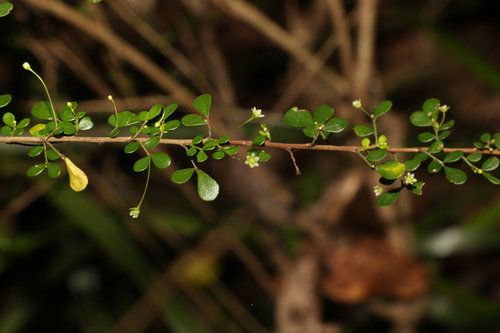
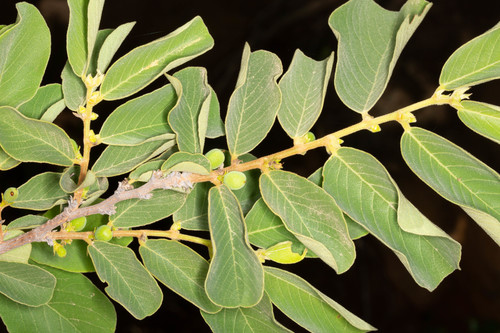
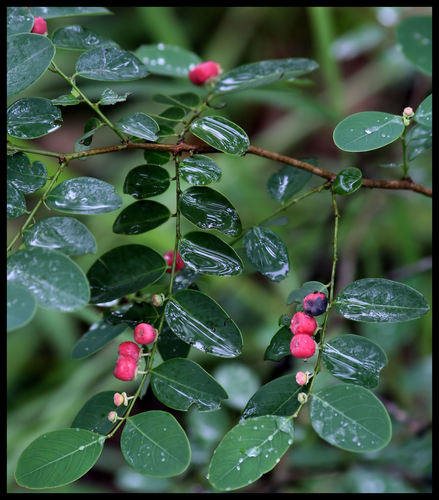
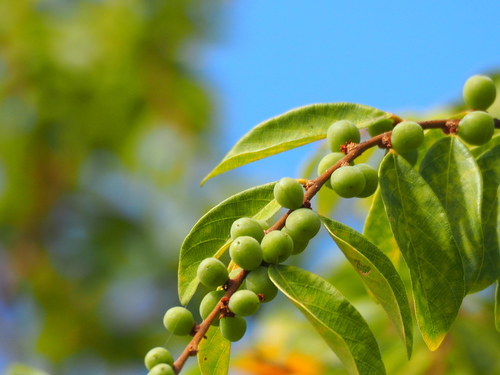
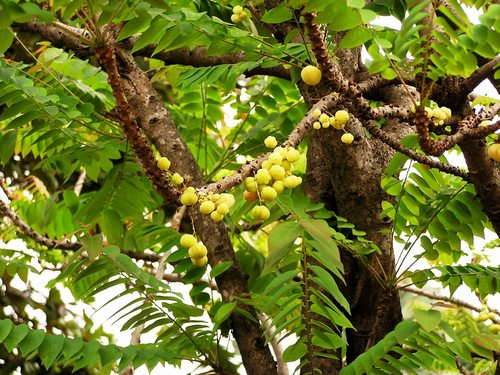
Phyllanthus acidus, commonly known as Otaheite gooseberry, grows as an intermediate between a shrub and a tree, reaching 2 to 9 meters (6½ to 30 feet) in height. It has a dense, bushy crown made up of thick, tough main branches. Clusters of deciduous, greenish branchlets 15 to 30 cm long grow at the ends of these main branches. The branchlets bear alternate leaves that are ovate or lanceolate in shape, with short petioles and pointed tips. Leaves measure 2 to 7.5 cm long, are thin, green and smooth on the upper surface, and blue-green on the lower surface. Overall, the Otaheite gooseberry tree strongly resembles the bilimbi tree. Its flowers may be male, female, or hermaphrodite. They are small, pinkish, and grow in clusters within 5-to-12.5-cm long panicles. Flowers develop on leafless sections of the main branches, in the upper part of the tree. The tree produces numerous densely clustered oblate fruits with 6 to 8 ribs. The fruits are pale yellow or white, waxy, crisp, juicy, and very sour. Each fruit contains 4 to 6 seeds inside a central stone. This tropical or subtropical species has an uncertain origin, though it may have originated in Madagascar. It is found across Asia, the Caribbean region, and Central and South America today. It was present in other parts of South Asia early; according to Eduardo Quisumbing, it was brought to the Philippines in prehistoric times. It spread across the Indian Ocean to Réunion and Mauritius, and crossed the Pacific to Hawaii. It reached the Caribbean in 1793, when William Bligh transported the plant from Timor to Jamaica. It is called "Grosella" in Puerto Rico. Other local names include ceremai or cerama in Guam and Micronesia, chùm ruột in Southern Vietnam, Kantuot /កន្ទួត in Laos and Cambodia, cerme and cermai in northern Peninsular Malaysia, and a wide range of regional names across India, the Maldives, the Philippines, Thailand, Grenada, and St. Lucia. In the United States, it grows in Hawaii, and is occasionally found in southern parts of Texas and Florida. It is also present in Ecuador, El Salvador, Nicaragua, Mexico, Colombia, Venezuela, Guyana, Suriname, the US Virgin Islands, Peru and Brazil. Otaheite gooseberry prefers moist soil. It can be grown from seed, and also propagated through budding, cuttings, and air-layering. The tree is cultivated for its ornamental value, as well as for food and medicinal uses. While it produces some fruit year-round, it is mainly harvested in January, except in South India where crops are produced in April–May and again in August–September. Fruit does not soften when ripe, so it is harvested when it begins to drop from the tree. This plant is also used for medicinal purposes. Peppered leaves are made into a poultice to treat sciatica, lumbago and rheumatism, though they have been observed to cause low blood pressure when combined with nitrates. Seeds are used as a cathartic, and carefully prepared root is used as a purgative. Syrup made from the plant is used to treat stomach complaints. In India, the fruit is eaten as a blood-enhancer for the liver; a medicinal paste called nellikai lekiyam, with Otaheite gooseberry fruit as its main ingredient, is given to children to boost their immunity.