About Phylidonyris pyrrhopterus (Latham, 1801)
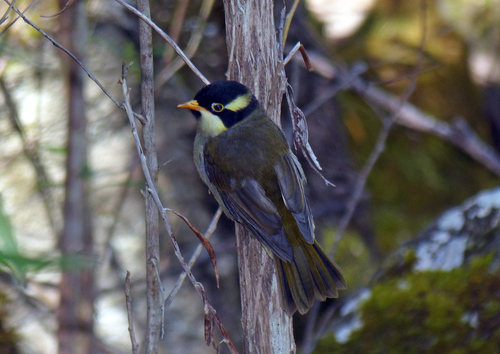
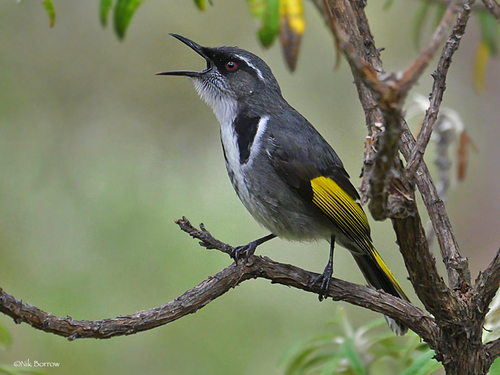
The crescent honeyeater, with the scientific name Phylidonyris pyrrhopterus, is a passerine bird belonging to the honeyeater family Meliphagidae, native to southeastern Australia. As a member of the genus Phylidonyris, it is most closely related to the common New Holland honeyeater (P. novaehollandiae) and the white-cheeked honeyeater (P. niger). Two subspecies are currently recognized; P. p. halmaturinus has a restricted range limited to Kangaroo Island and the Mount Lofty Ranges in South Australia. This species has dark grey plumage and paler underparts, marked by yellow wing-patches and a broad black crescent outlined in white that runs down the sides of the breast. It shows slight sexual dimorphism: female crescent honeyeaters are duller in color than males. Juvenile birds resemble females, though the yellow wing-patches of male nestlings can be easily distinguished from other young birds. Males have a complex, variable song that can be heard year-round. They sing from exposed perches, and perform song flights during the breeding season. Crescent honeyeaters live in areas of dense vegetation, including sclerophyll forest, alpine habitats, heathland, parks, and gardens. Their diet consists of nectar and invertebrates. They form long-term breeding pairs, and often remain committed to a single breeding site for multiple years. The female builds the nest and cares for most of the two to three young, which become independent within 40 days of egg-laying. Parent birds use a range of anti-predator strategies, but nestlings may still be taken by snakes, kookaburras, currawongs, or cats. Although the species faces a number of threats, its population size and distribution are large enough for it to be listed as Least Concern for conservation. Scattered populations of the crescent honeyeater have been recorded on the Central Tablelands, the Mid North Coast, and the Hunter Region of New South Wales. The species is widespread across areas of New South Wales that are south of Dharug National Park and east of Bathurst. In Victoria, it is widespread across the area from the New South Wales border southwest to Wallan, with scattered populations recorded further west. It is widespread across most of Tasmania, only being more sparsely distributed in the northeastern part of the state. In eastern South Australia, it is restricted to sclerophyll forest, with isolated populations recorded in the Mount Lofty Ranges and on Kangaroo Island. Local population influxes have occurred outside the species' normal range in response to habitat changes. Recorded population densities range from 0.3 birds per hectare (0.12 per acre) near Orbost, to 8.7 pairs per hectare (3.5 per acre) in Boola Boola State Forest, also located in Victoria. The crescent honeyeater occupies a wide variety of habitats, including coastal heath, rainforest, wet sclerophyll forest, mountain forest, alpine woodland, damp gullies, and thick tea-tree scrub, all of which reflect its preference for dense vegetation. It is frequently recorded in wet sclerophyll forest dominated by eucalypts, with a thick mid-story and understory of shrubs such as blackwood, silver wattle, Cassinia, Prostanthera, and Correa. At higher altitudes, it lives in alpine heathlands and woodlands of stunted eucalypt or conifers. The movements of crescent honeyeaters within their range are not fully understood. There is widespread evidence that many populations seasonally migrate to lower altitudes during cooler months, but a portion of the population remains sedentary year-round. Autumn and winter migration to lowland coastal areas occurs in southern Tasmania, where it is not uncommon to find the species in urban parks and gardens; this pattern is also seen in Gippsland, and on the New South Wales Central and South Coast. In the Sydney region, some birds appear to move down from the Blue Mountains to Sydney for the cooler months, while others remain in either location for the entire year. The species is only seen in alpine and subalpine areas of the Snowy Mountains during warmer snow-free months, mainly from October to April. Other crescent honeyeater populations follow a more nomadic pattern, moving to follow food sources; this nomadic behavior has been recorded in the Blue Mountains and parts of Victoria.