About Phylidonyris novaehollandiae (Latham, 1790)
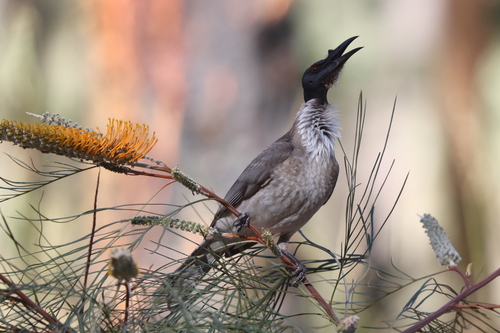
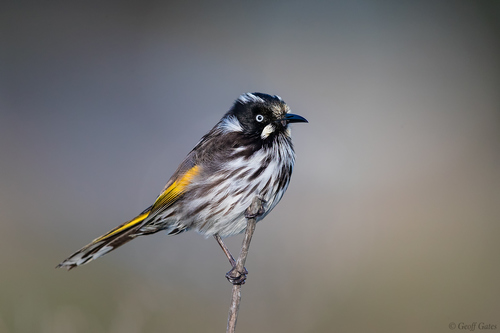
This species, the New Holland honeyeater, measures around 18 cm (7.1 in) in length. Its plumage is mainly black, with a white iris, white facial tufts, and yellow margins along its wing and tail feathers. It is highly active and rarely stays still long enough for observers to get a clear extended view. When a predator such as a bird of prey approaches, a group of these honeyeaters will gather and produce a warning call. Males and females look very similar; the only consistent difference is that females are on average slightly smaller. Individuals under one year old have similar overall colouring to adults, but have grey eyes, a yellow gape, and yellow 'whiskers' near the nares. The New Holland honeyeater appears to be socially monogamous with no evidence of co-operative breeding, though this observation has not yet been formally examined. New Holland honeyeaters get most of their carbohydrate needs from flower nectar. Because of this nectar-feeding habit, they are key pollinators for many flowering plant species, many of which are endemic to Australia, including Banksia, Hakea, Xanthorrhoea, and Acacia. They may also consume honeydew, a sugary secretion produced by insects in the family Psyllidae. Although they feed primarily on nectar, they are not strictly nectarivorous. Nectar does not provide protein, so these honeyeaters must supplement their diet with protein-rich invertebrates such as spiders and insects. They sometimes feed alone, but more often gather in feeding groups.