About Phylidonyris niger (Bechstein, 1811)
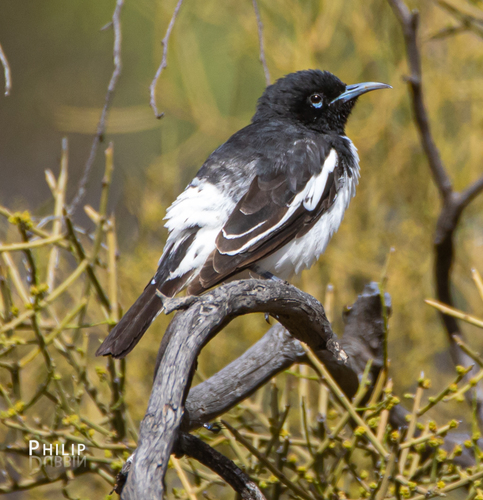
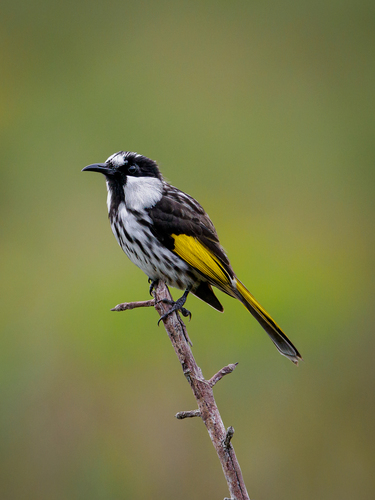
The white-cheeked honeyeater, scientifically named Phylidonyris niger (Bechstein, 1811), is a medium-sized black and white honeyeater. It has a long, sturdy down-curved bill, large bright-yellow patches on its wings and tail, and a prominent large white cheek patch on its mostly black head. It has dark brown eyes and a long, tapering white brow line. Juvenile birds have a yellow gape and yellow brow, and their plumage is dusky or dull brownish. This species is gregarious, active, and noisy, with swift, erratic flight. Adults measure 16–20 cm (6.3–7.9 in) in length; males weigh 15.5–25 g (0.55–0.88 oz) and females weigh 15.5–20 g (0.55–0.71 oz). Its vocalizations include a distinctive yapping call "chwikup, chwikup", a melodious "chippy-choo, chippy-choo", and a higher, repeated lilting "twee-ee-twee-ee" call given during display song-flight in the breeding season. The white-cheeked honeyeater is endemic to eastern and south-western Australia. In eastern Australia, its range extends from east of the Great Divide in Queensland, through coastal New South Wales, and becomes scattered as far south as Jervis Bay. In south-western Australia, it occurs from Israelite Bay, east of Esperance, to the Murchison River in Kalbarri National Park. It most often inhabits moist heathlands, paperbark swamps, wetlands, and forests or woodlands with a heath understory. It occurs in both temperate and subtropical zones, and can also be found in parks, gardens, and flowering street trees throughout its range. It is not wary of humans and adapts easily to human settlement, though it is sometimes killed by domestic cats. White-cheeked honeyeaters feed mainly on nectar from the flowers of Banksia, eucalypt, Grevillea, bottlebrush, heath, Darwinia (in south-west Western Australia), Calothamnus, and Dryandra species. They also glean insects from bark, or sally and hover to catch insects in the air. They often feed busily and noisily in small groups, and may feed alongside New Holland honeyeaters.