About Phyla lanceolata (Michx.) Greene
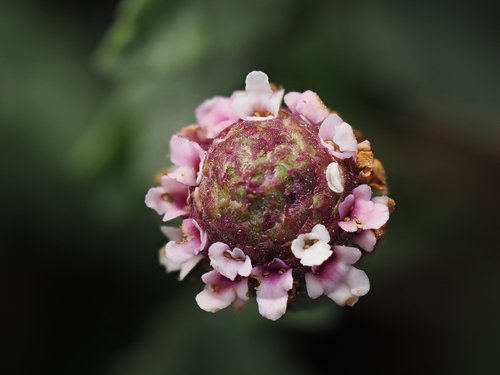
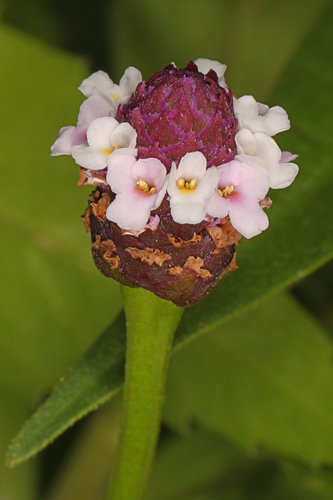
Phyla lanceolata (Michx.) Greene is a species of flowering plant in the verbena family, with the common names lanceleaf fogfruit, fogfruit, and frogfruit. It is native to the southern half of North America. It grows across most of the United States, excluding the northwestern quadrant, and across much of Mexico. It occurs in many types of moist and wet habitat, including disturbed areas such as irrigation ditches. This is a perennial herb that grows in a decumbent, mat-like form, with spreading, trailing stems that can reach up to 50 centimeters (19.7 inches) long, and sometimes produces roots at its nodes. Its leaves are lance-shaped or nearly oval, growing up to 6 centimeters (2.4 inches) long, with toothed or partially toothed edges. The inflorescence grows from a peduncle several centimeters tall, starting as a spherical spike of flowers that elongates into a cylindrical shape as fruits develop. The tiny, densely packed flowers are white, sometimes with a blue or purple tinge. This species is similar to the closely related Phyla nodiflora, but differs by having much longer and more pointed leaves. Both species are common as weeds, and are also found in ornamental settings. An older scientific name for this species is Lippia lanceolata, and some older references list 'frogfruit' as its common name. The Acadian French name for this plant is "caille eau", which comes from the superstition that it can curdle water.