About Phrynus marginemaculatus C.L.Koch, 1840
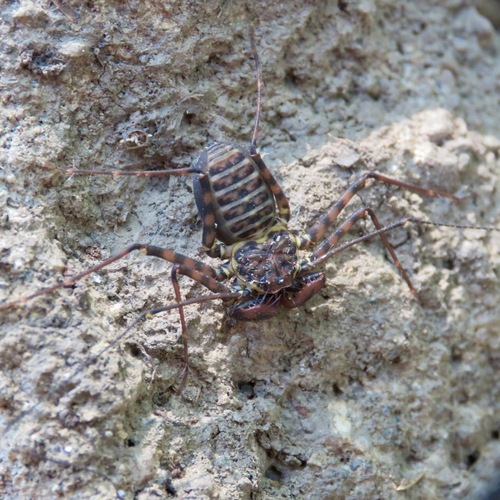
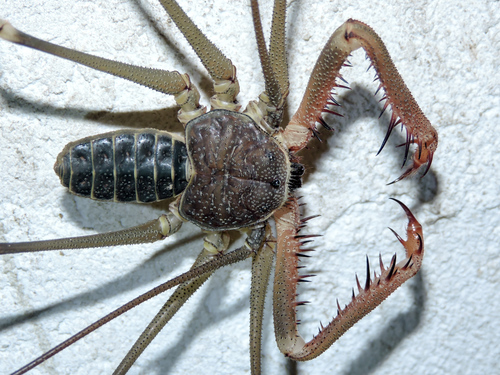
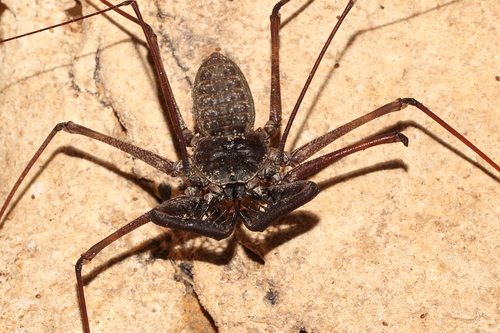
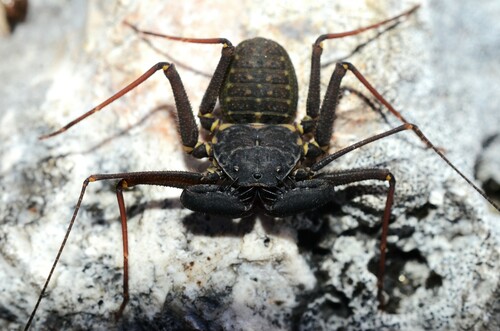
The body of Phrynus marginemaculatus can grow up to 18 millimetres (0.71 in) long, while its front legs can reach 100 millimetres (3.9 in) in length. This species has eight legs total: six are used for walking, and the front two function as sensory organs to detect prey and navigate the animal's environment. Its cephalothorax is wider than it is long, and bears eight eyes: one pair positioned at the front, and three additional pairs located on the sides. Phrynus marginemaculatus does not produce venom, and instead has pinching pedipalps plus a pair of smaller chelicerae. For reproduction, male and female Phrynus marginemaculatus engage in ritualized displays that follow a fixed stereotyped sequence. Males deposit a spermatophore, which the female retrieves to fertilize her eggs. After a period ranging from a few weeks to several months, the female produces a brood sac that holds between 12 and 20 eggs. The eggs develop over three months; after hatching, the female carries the first instar nymphs on her back for approximately ten days, until they molt. Young Phrynus marginemaculatus take around two years to reach adulthood, and adult individuals have a life expectancy of an additional two to three years.