About Phrynus longipes (Pocock, 1894)
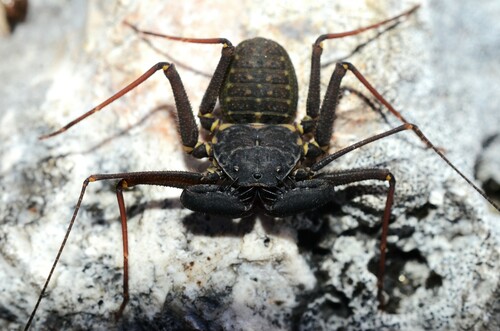
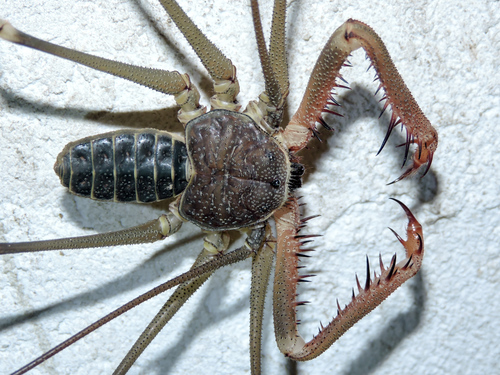
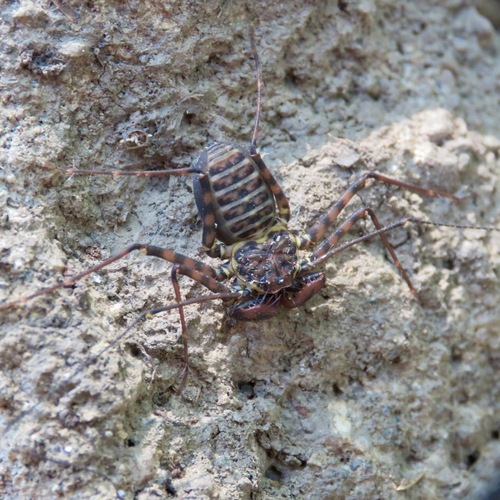
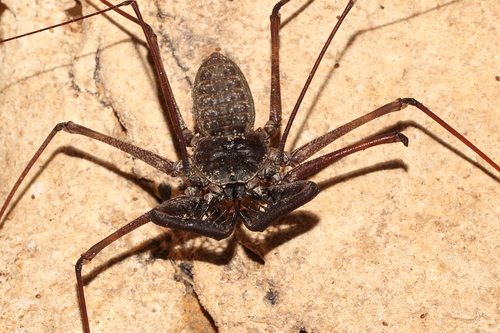
Phrynus longipes is a species of amblypygid first described by Pocock in 1894. The body of this species rarely exceeds three-quarters of an inch in length, while its front legs have been recorded reaching almost ten inches long. Like almost all arachnids, it has two sets of four legs; however, only the last six legs are used for walking, while the first pair functions as sensory organs. Like all amblypygids, Phrynus longipes produces neither venom nor silk. Similar to many other amblypygid species, it exhibits sexual dimorphism, and its sexually dimorphic pedipalps are used for territorial displays and combat. Phrynus longipes is found across multiple localities throughout the Caribbean, where the male holotype of the species was collected in Haiti. It prefers warm, wet climates, and is typically found in forests across Central America and the northernmost part of South America, specifically in wet subtropical forest habitats. While it can live in a variety of microhabitats including caves, trees, and shrubs—each of which offers different evolutionary advantages and disadvantages—Phrynus longipes prefers to live near or within large tree stumps. This preference is thought to stem from the fact that most of the species' prey also tends to gather around large tree stumps. Sexual interactions between Phrynus longipes range in length from as short as one hour to as long as eight hours. This species mates via indirect sperm transfer that uses a sclerotized spermatophore. Pre-mating behavior is highly consistent, and is usually performed by the male when courting the female; these behaviors include jerking motions and movements of the pedipalps. After these courtship interactions, the spermatophore is deposited into the female, which ultimately leads to fertilization and the development of an egg sac. Polygyny is the most common mating pattern for Phrynus longipes: males are able to mate freely with multiple females, while females cannot mate with multiple males freely because they care for the egg sac. In cases where polygyny does not occur, Phrynus longipes has been observed engaging in repeated mating with the same partner. This means one male will mate multiple times with the same female to ensure he sires every egg in her clutch. This form of monogamous mating better guarantees that the male will produce a large number of his own offspring.