About Phrynosoma hernandesi Girard, 1858
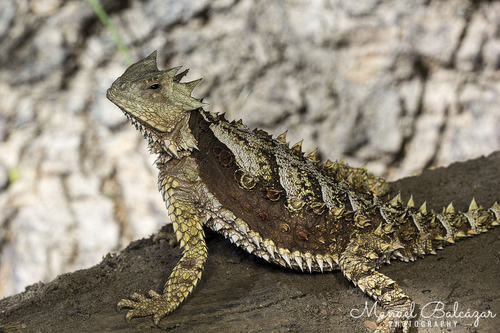
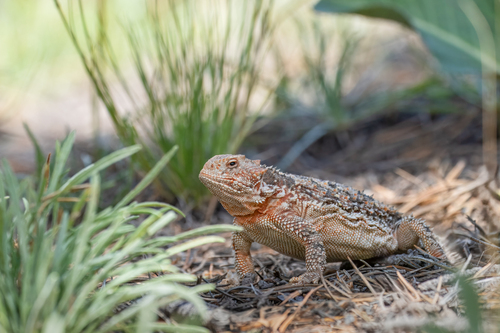
The greater short-horned lizard, Phrynosoma hernandesi, is often confused with its close relative the pygmy short-horned lizard, Phrynosoma douglasii. Both share the same basic body form, with small pointed scales covering the head and back. Before recent mitochondrial DNA evidence was collected, P. hernandesi was classified as the same species as P. douglasii. They are now recognized as separate species; P. douglasii lives in the northwestern United States and extreme southern British Columbia. When the two are compared at full adult size, they are easy to tell apart, as P. douglasii is much smaller. P. hernandesi is a species with high physical variation: different geographic populations have differences in color, pattern, and size, and some authorities recognize five separate subspecies. The greater short-horned lizard ranges from 2 to 5 inches (5.1 to 12.7 cm) in snout-to-vent length (SVL). It has a flat, squat body with scales forming a "crown" around the top of the head, a snub-nosed profile, and short legs. A single row of pointed scales fringes the trunk, while the belly scales are smooth. Its base body color is gray, yellowish, or reddish-brown, with two rows of large dark spots along the back. When the lizard feels threatened or acts aggressively, its body color becomes more intense. Females grow larger than males: females average about 7 cm (around 2.75 inches) in SVL, with a maximum total length including the tail of about 15 cm (around 6 inches) and an average weight of about 18 g (0.63 oz). Males only reach an SVL of about 5 cm (around 2 inches) and average a weight of about 10 g (0.35 oz). The adult male's dermatocranial shape matches what would be expected for a subadult female of the same body size. The greater short-horned lizard is the most widely distributed horned lizard in North America, and occupies a wider range of habitats than other horned lizards. Its distribution extends west into central Nevada, east into North and South Dakota, north to southern Saskatchewan and Alberta, and south from eastern New Mexico to central Mexico, with small isolated populations in Trans-Pecos Texas. This species mostly lives in arid mountain environments, at elevations between 900–11,300 feet (170–3440 m). It is the only member of the genus Phrynosoma found in Wyoming, which has Phrynosoma as its state reptile. The greater short-horned lizard is classified as an endangered species in Saskatchewan and Alberta. The species occupies habitats ranging from semiarid plains to high elevation mountain areas. It is commonly found in a wide variety of habitat types including shortgrass prairies, sagebrush deserts, and juniper, pine, or fir forests. The soil in its habitats may be stony or rocky, but usually contains fine loose soil or sand. The greater short-horned lizard is more tolerant of cold than other horned lizard species, which allows it to survive at higher elevations and across a larger distribution in cooler regions than related species. Mating for P. hernandesi occurs in spring, from May to June. This species is viviparous, meaning it gives birth to live young. Females give birth to between five and 48 offspring from July to September. Newborn young measure about 24 mm (0.94 in) SVL and weigh approximately 1 g (0.035 oz) each. Newborns do not yet have developed horns, and can care for themselves within a few hours of birth, but cannot crawl fully until they are one day old. Males become sexually active after their first year of life, while females typically require two years before they can begin reproducing.