About Phrynosoma cornutum (Harlan, 1825)
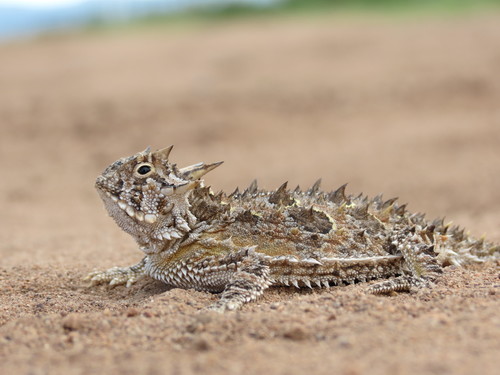
Phrynosoma cornutum, commonly called the Texas horned lizard, is the largest-bodied and most widely distributed of the approximately 21 species of horned lizards native to the western United States and Mexico. This species displays sexual dimorphism: females are larger, reaching a snout-vent length of around 5 inches (13 cm), while males reach around 3.7 inches (9.4 cm). Phrynosoma cornutum has characteristic horns across its body: the two largest sit atop its head, with one additional pair on the brows and another on the jawline, alongside lines of spikes running along the sides of the torso and the dorsal ridges of the back. Its coloration changes to match the local ground for camouflage, ranging from yellow or reddish-brown in desert habitats to tannish brown in prairies, and may become more vibrant during the mating season. It also has dark lines extending from the eyes to the tips of the horns, plus a distinctive solid white line marked with a few black circular spots on each side. Like all members of the genus Phrynosoma, the Texas horned lizard is endemic to North America, occurring in south-central United States and northeastern Mexico. Its native distribution covers southeastern Colorado, central and southern Kansas, central and western Oklahoma and Texas, southeastern New Mexico, and extreme southeastern Arizona. In Mexico, it is found in extreme eastern Sonora, most of Chihuahua, northeast Durango, northern Zacatecas and San Luis Potosí, and most of Coahuila, Nuevo León, and Tamaulipas. Its elevation range extends from sea level on barrier islands along the Gulf Coast of Texas and Tamaulipas up to around 1,830 meters, and it is absent from higher elevations within its overall range where other Phrynosoma species occur, such as the Sierra Madre Oriental. It occupies ecoregions including the southern Great Plains, Edwards Plateau, Tamaulipan mezquital, Chihuahua Desert, Llanos el Salado, and many peripheral and marginal areas of these regions. The eastern limits of its recorded distribution, in the piney woods of east Texas, western Louisiana, and the Ozark Mountain forests of western Arkansas and Missouri, are most likely the result of introductions, though some researchers argue these records are of natural relict populations. Many records of introduced Texas horned lizards outside their native range come from released or escaped pet trade individuals from the early and mid-twentieth century, with sightings reported in Alabama, Arizona, Colorado, the District of Columbia, Illinois, Indiana, Kentucky, Michigan, Mississippi, Nebraska, North Carolina, Tennessee, Virginia, and Wyoming. None of these sightings correspond to established, breeding populations. A small number of stable populations, some documented for over 50 years, are found in Florida, Georgia, and South Carolina, but these populations do not appear to be dispersing or spreading.