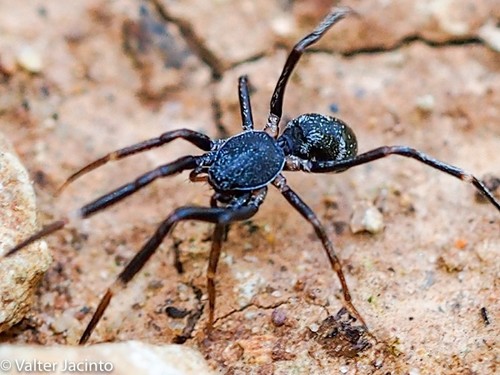
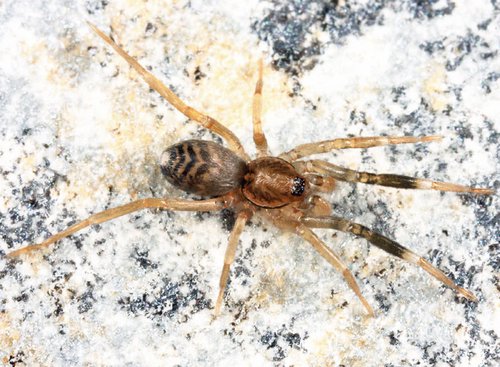
About Phrurolithus festivus (C.L.Koch, 1835)
Scientific name: Phrurolithus festivus (C.L.Koch, 1835)
Characteristics: Per Sven Almquist (2006), female P. festivus have a body length ranging from 2.7 to 3.8 millimeters, with an average of 3.1 ± 0.2 millimeters. Males range from 2.6 to 3 millimeters, with an average of 2.8 ± 0.1 millimeters. Like all members of the Phrurolithidae family, this is a small spider species. Its basic body structure matches that of other Phrurolithus species. The leg order, as seen in many spiders, follows the formula 4-1-2-3.
The abbreviations for directional positions used here are: d = dorsal (above), pl = prolateral (laterally in front), v = ventral (below). In this species, the opisthosoma (abdomen) has an angular shape, and is roughly the same width at the anterior (front) end as it is at the posterior (back) end.
Genital morphological characteristics: The pedipalps (modified appendages) of male P. festivus are almost black, while the femora are dark brown. Male pedipalps can sometimes be distinguished from those of other male Phrurolithus species by the retrolateral (laterally recessed) apophysis (chitinized process) on the tibia. In this species, this process is comparatively very large and has a shovel-shaped form. The basal (base-located) part of the male's bulb (sex organ) is prominent. The tegular (posterior) apophysis on each pedipalp is broadly shaped, with a curved tip. The curved embolus (the third and final sclerite, or hard part, of the bulb) has a peg-like form.
The epigyne (female sex organ) of P. festivus is sometimes distinguished from other species in the genus by a posteriorly sclerotized (hardened) plate. The sex organ extends slightly past the epigastric (stomach-located) furrow. The epigyne has a relatively small copulatory opening, and the copulatory ducts are comparatively short and wide. The primary spermathecae (seminal pockets) are arranged transversely, while the secondary spermathecae are large and oval-shaped.
Life cycle and phenology: Like other spiders, the life cycle of P. festivus is divided into reproduction, oviposition, and adolescent stages. The activity period (phenology) for adult females falls between February and October, and between March and October for adult males. Parts of the species' life cycle, along with its prey spectrum, were analyzed in 2011 by Stano Pekar and Martin Jarab.
When a male P. festivus approaches a female, it immediately moves toward her to begin mating; no courtship behavior has been confirmed for this species. Per Pekar and Jarab, mating lasts an average of 252 ± 15.7 minutes, and uses position III: the male stays above the female, facing the opposite direction. Mating occurs during daylight hours on open surfaces such as tree bark or substrate. Unlike some other myrmecomorph (ant-mimicking) spiders, P. festivus does not use protective measures during reproduction, while unrelated ant-mimicking jumping spiders of the genus Myrmarachne mate inside a web.
Some time after mating, still within the same mating year, the female lays an average of 4 eggs in a single egg cocoon. The egg clutches of P. festivus contain far fewer eggs than those of most other spiders. While this small clutch size is also seen in other myrmecomorph spiders and can be linked to a narrower opisthosoma adapted for an ant-like shape, the low egg count in P. festivus is probably due to the species' generally small body length. Larger body length may be associated with larger clutches, though this difference is not statistically significant.
Per Pekar and Jarab's observations, a mated female P. festivus produces an average of two sequential egg cocoons, spaced at intervals. This low number of cocoons also appears in some other myrmecomorph spiders, however more strongly ant-mimicking myrmecomorphs with a constricted opisthosoma, such as the dwarf ant jumping spider Synageles, produce significantly more cocoons, between seven and eight. Since cocoon counts are consistently lower in less strongly ant-mimicking species like P. festivus, research has confirmed that iteroparity (the ability to reproduce multiple times) is not affected by ant mimicry.
Like all spiders, spiderlings grow through multiple instar (molting) feeding stages. It is unknown how newly hatched spiderlings disperse. Ballooning (spider flight) can be ruled out for this species, as it can for other myrmecomorph spiders, because these spiders generally prefer to stay in areas close to ants.