About Phrontis vibex (Say, 1822)
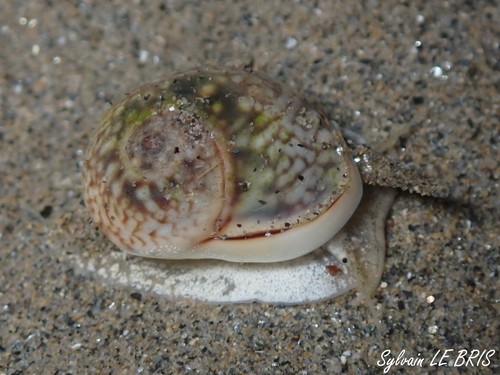
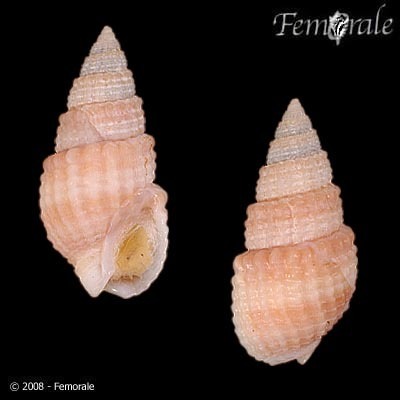
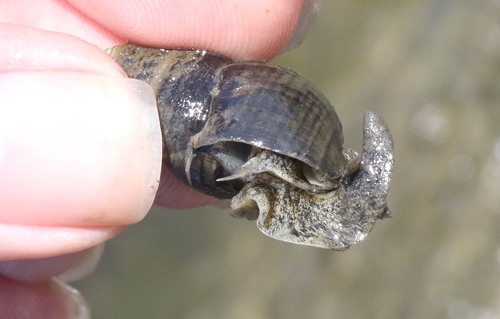
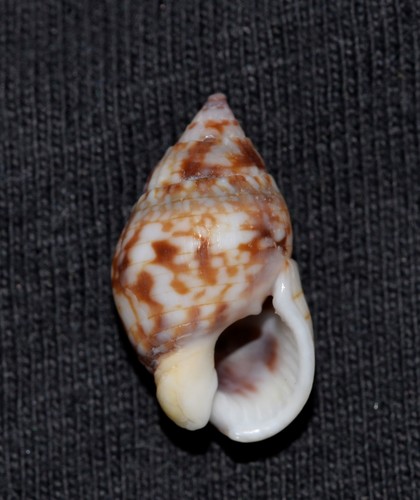
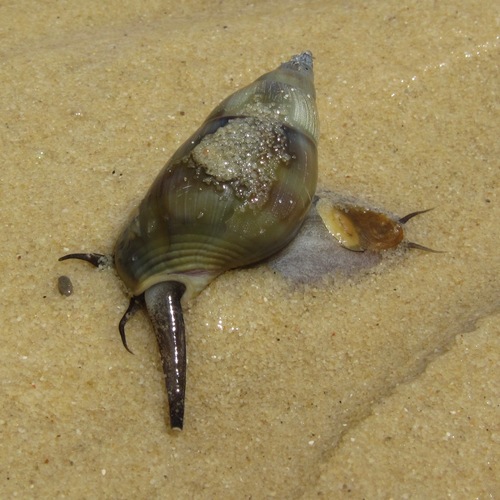
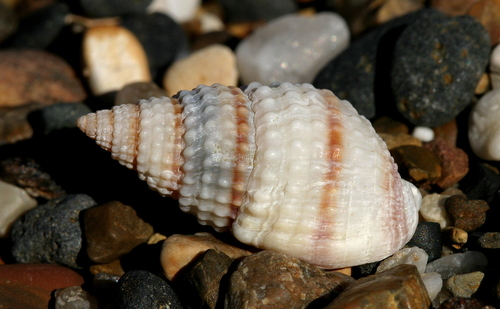
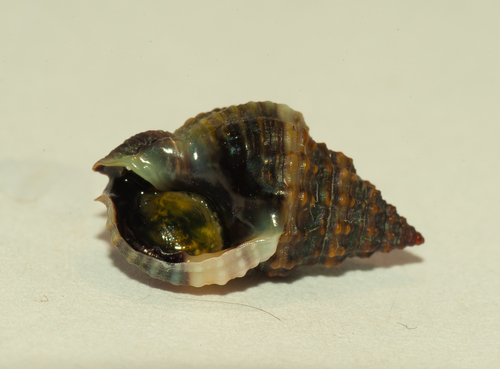
This species is currently recognized under the scientific name Phrontis vibex (Say, 1822), and is also referenced as Nassarius vibex in distribution records. The shell of this species measures between 10 mm and 20 mm in length, with an overall ovate, conical shape. The spire is made up of six or seven indistinct, subconvex whorls. These whorls are plaited along their entire length, and crossed by fine, very closely spaced transverse striae; the striae on the base of the shell are more prominent than those elsewhere. Longitudinal folds fade gradually on the right side of the body whorl, where only nodosities remain at the upper part of the whorl. The aperture is rounded and whitish on the outside; the internal cavity of the shell is brown, marked with transverse bands. The outer lip has an external border, and its inner surface is decorated with small, fine striae. The columella is arcuated, covered by a fairly wide callosity that is brown in its upper section and white toward the base. The base of the columella is adorned with small guttules. The shell's base color is olive, with a single white or yellowish band. The folds and tubercles on the upper portion of the body whorls are sometimes whitish. This is a marine species with a geographic range spanning from 41.6°N to 27°S, and from 97.38°W to 34.9°W, found in the northwest Atlantic, Gulf of Mexico, Caribbean Sea, and southwest Atlantic. It has been recorded off the coasts of the following locations: USA (Massachusetts, New York, New Jersey, Virginia, North Carolina, South Carolina, Georgia, East Florida, West Florida, Louisiana, Texas); Mexico (Tabasco, Veracruz, Campeche State, Yucatán State, Quintana Roo); Nicaragua; Lesser Antilles; Costa Rica; Cuba; Panama; Colombia; Venezuela (Gulf of Venezuela); Jamaica; Virgin Islands (St. Croix); and Brazil (Para, Maranhao, Ceara, Rio Grande do Norte, Pernambuco, Alagoas, Bahia, Rio de Janeiro, São Paulo, Parana, Santa Catarina).