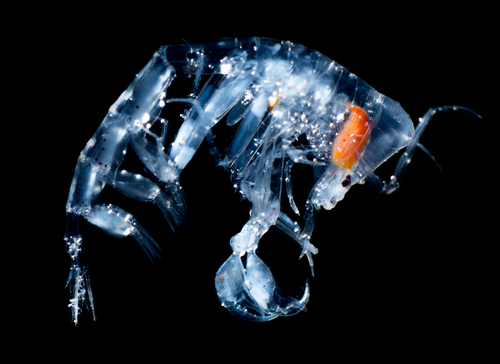
About Phronima sedentaria (Forskål, 1775)
Phronima sedentaria (Forskål, 1775) is the largest and most abundant species in the family Phronimidae. This species displays clear sexual dimorphism: males have longer, more prominent antennae than females, who have short, reduced antennae. The two sexes are also further distinguished by a significant size difference: females can reach up to 42 mm (1.7 in) in length, while males only grow to 15 mm (0.6 in). This species has a complex optical system that uses two sets of compound eyes. Both sets rely on bundles of crystalline cones to process visual information: one set, called medial eyes, faces toward the dorsal (top) side of the body, while the second set (lateral eyes) faces toward the side. The medial eyes have very large compound eyes that cover the entire dorsal surface of the head to collect light, but only a very small retina. Light is guided through the crystalline cones, which act like optical fibers, until it reaches the small medial retina. This arrangement is hypothesized to help the species camouflage from mid-water predators. Most of the animal’s body is transparent, but retinas must be opaque to work correctly; this setup allows the species to have a large light-collecting surface paired with the small opaque retina needed for function. The medial compound eyes have very fine resolution, with an angle of 0.25° between individual ommatidia. This fine resolution comes at the cost of a limited visual field: each eye can only see an angular width of 15°, and the two visual fields overlap heavily, giving the species fine binocular vision in a narrow beam that points directly upward. Phronima sedentaria occurs in temperate, subtropical, and tropical waters across all the world’s oceans, including the Mediterranean Sea. It typically inhabits midwater pelagic environments, but can migrate all the way to the ocean surface. Phronima sedentaria most often forms symbiotic relationships with tunicates in the genera Pyrosoma, Doliolum, and Salpa. The exact classification of this symbiosis is uncertain, as instances of commensalism, parasitism, and predation have all been recorded. However, some research suggests most members of the suborder Hyperiidea, which this species belongs to, exhibit parasitic behavior. Female P. sedentaria live inside the barrel-shaped bodies of salps, pyrosomes, and cnidarians. They use their strong pleopods to propel these barrel host homes through the water, and can somersault rapidly inside the barrel to quickly change direction. Swimming speed while inside a barrel is three to four times slower than swimming without a barrel. Most barrels are asymmetrical, with one opening three times larger than the other. To build their barrel homes, females first find a suitable host, then either cut into the organism or enter through an existing opening. Once inside, the female consumes the host’s internal tissue and carves out the gelatinous interior, killing the host and leaving only the outer tunic layer intact. The tunic’s cells are thought to provide P. sedentaria with multiple benefits, including UV protection, acid storage, and defense against microorganisms like bacteria. In lab experiments where access to potential hosts was limited, females have been observed competing for barrels. While prey organisms like salps, pyrosomes, and cnidarians double as homes for P. sedentaria’s young and feeding platforms, the species also hunts other zooplankton including krill, arrowworms, and other crustaceans. P. sedentaria uses different feeding methods depending on its food source, but its leading front pereiopods (front legs) are the primary structure used in all cases. Feeding structures including the mandible, maxillipeds, and maxillae break food into small pieces that can pass through the esophagus. Feeding happens primarily at night, when this species undergoes a vertical migration of 200–350 meters up to the ocean surface. Studies show P. sedentaria cannot tolerate temperatures outside the range of 8–25 °C (46–77 °F), which explains its behavior: it stays in cooler deep water (300–600 meters deep) during the day, and moves into warmer shallow water (0–25 meters deep) at night. During the day, P. sedentaria typically migrates into hypoxic areas such as the Oxygen Minimum Zone, which leads to low metabolic rates and reduced physical activity. Known predators of P. sedentaria include longnose lancetfish, European flying squid, Pacific pomfret, albacore, and skipjack tuna. Female P. sedentaria can produce up to 600 eggs at a time. Juveniles develop early inside a specialized brood pouch on the mother called the marsupium. After finding a suitable host barrel, the female converts it into a nursery for her young. She uses her pleopods and anterior pereiopods to move offspring out of the marsupium, while her posterior pereiopods grip the barrel to keep her stable. Once inside the barrel, the young arrange themselves into a ring around the inner center of the structure. They maintain this ring shape until the mother brings food, which the offspring feed on before returning to their organized formation. The young also use the barrel itself as a food source. Offspring develop inside the barrel home until they reach prematurity, at which point they can feed and survive on their own. Development proceeds through growth stages separated by molting. Each molt adds a new segment to the rear pleopods. Sexual dimorphism becomes visible shortly after individuals reach prematurity.

