About Phoxinus phoxinus (Linnaeus, 1758)
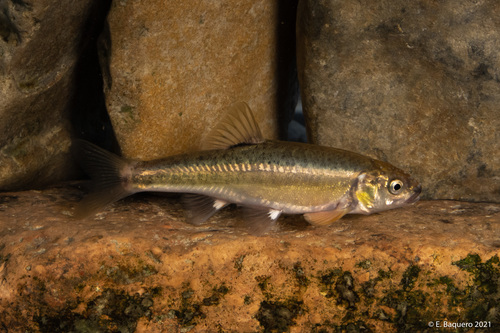
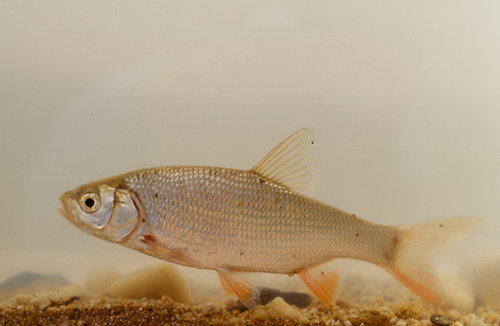
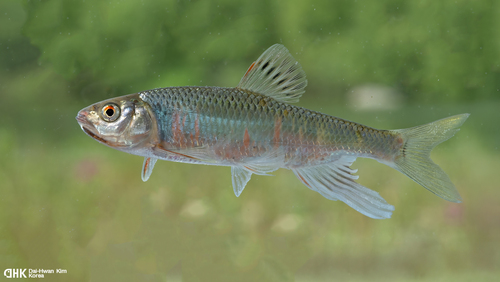
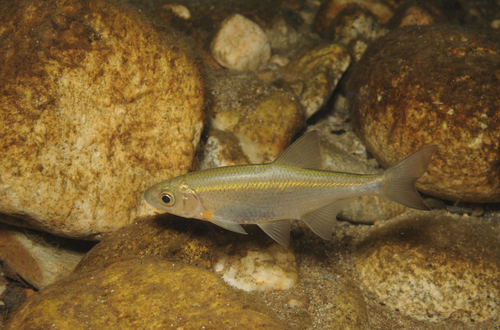
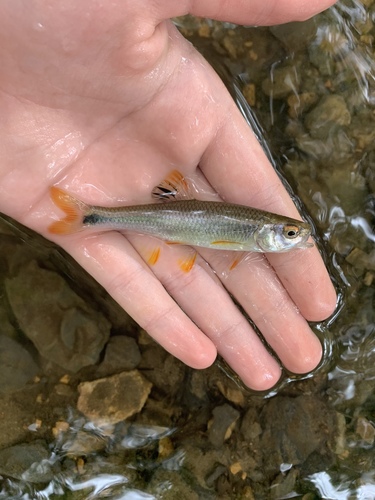
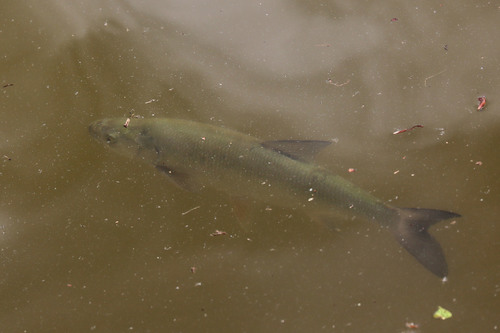
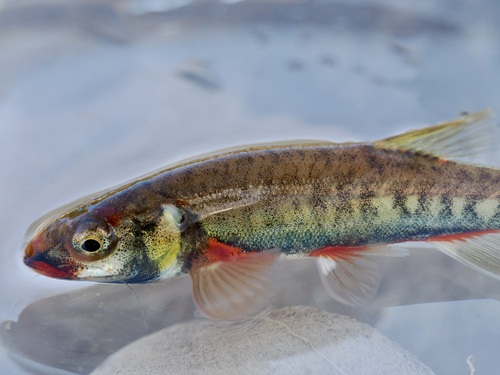
Phoxinus phoxinus, also called the common minnow, is a small fish that reaches a maximum total length of 14 centimetres (5+1⁄2 in), and typically measures around 7 centimetres (3 in) long. Its dorsal fin has 3 spines and 6 to 8 soft rays, while its anal fin also has 3 spines and 6 to 8 soft rays. This species has 38 to 40 vertebrae. It can be told apart from similar species found in Europe by several traits: its lateral line normally extends beyond the anal fin origin; it has a line of vertically elongated blotches along the lateral line, each with a depth equal to 1/3 to 1/2 of the body depth at the same position, and these blotches often fuse together to form a midlateral stripe; the depth of its caudal peduncle is 2.6 to 3.1 times its length. Scales on the breast grow in patches, and these patches are separated by unscaled areas, though they are rarely connected by a row of 1 to 2 scales. The snout length makes up 29 to 34% of the total head length, and is 1.1 to 1.4 times the diameter of the eye. The origin of the anal fin sits in front of the base of the last dorsal fin ray. Its caudal fin has 19 soft rays. The back is usually brownish-green, and this color is separated from the whitish-gray underside by the midlateral stripe or blotches described above.
Phoxinus phoxinus is native to river catchments that drain into the North Sea and English Channel, ranging from the Rhine system south to Normandy, and is also native to Great Britain. In Scotland, it is considered an introduced non-native species, and this is also likely the case in Ireland. It has probably been introduced to other areas, including Norway.
The common minnow occurs in a wide range of cold, well-oxygenated aquatic environments, and often lives in the same area alongside salmonids. Habitats include small fast-flowing streams, and in the more northerly parts of its range, it also lives in large lowland rivers. It can also be found in still water bodies, ranging from small mountain lakes to large oligotrophic lakes. For spawning, it requires clean gravel areas in well-oxygenated flowing water, or on wave-washed lake shores. To overwinter, it needs deep pools with low current that have a coarse substrate where the fish can hide.