About Photinus pyralis (Linnaeus, 1767)
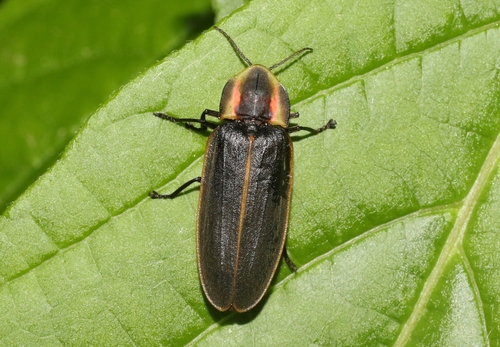
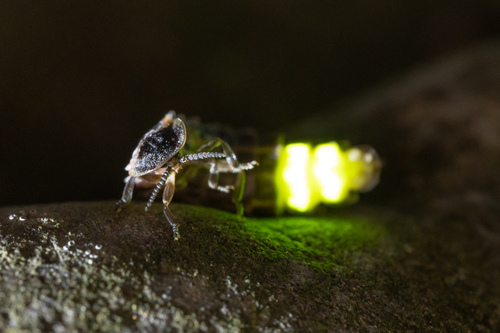
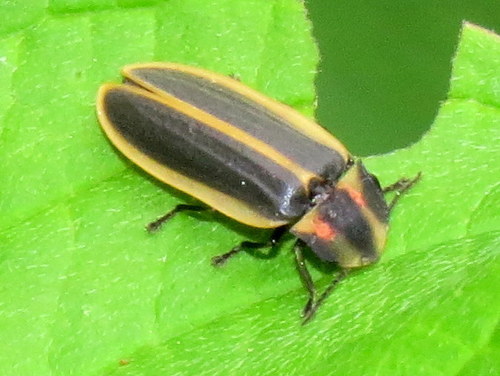
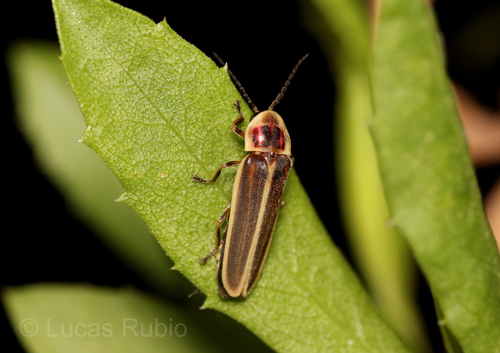
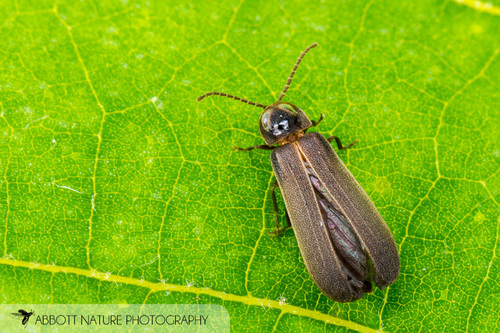
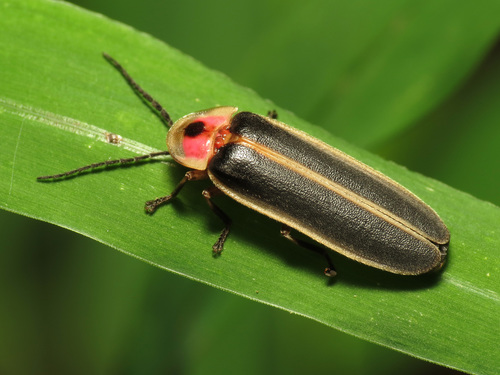
Photinus pyralis, commonly known as the common Eastern firefly, is a small soft-bodied beetle that ranges from 9–19 mm (0.4–0.7 in) in length. Its body is flat and colored black or brown, with hardened wing coverings called elytra that extend the full length of its thorax and abdomen; these elytra have a yellow border. Its head shield, the pronotum, is pale yellow with a central black dot, surrounded by pink or red markings. Both males and females of this species have light-emitting organs on the underside (ventral side) of their abdomens. In males, this organ spans the full length of the last three abdominal segments, while in females it is only found in the second-to-last abdominal segment. Like most flying firefly species, Photinus pyralis is active at night (nocturnal).
Photinus pyralis is widespread across the eastern half of North America. It can be found in a wide variety of habitats, ranging from temperate to tropical environments. Natural habitats include meadows, fields, wetlands, desert canyons, and dense forests, and while the species can thrive in all these areas, it requires moisture to survive through all life stages. It is especially attracted to areas with damp soil and long grasses, which provide better concealment for females and offspring.
Population studies have investigated whether P. pyralis has always been endemic to the northeast regions of North America, in part because the species currently occupies a wide variety of habitats across the continent. Genetic research has found that the ancestral North American population of P. pyralis originated in Texas during the Miocene epoch, before migrating to the central states of the U.S. and, more recently, the Northeast coast. By tracking single nucleotide polymorphisms (SNPs) and other genetic markers, researchers have concluded that common Eastern fireflies likely migrated during interglacial periods, which may explain the divergence of other Photinus species.
Like all beetles, the common Eastern firefly has a four-stage life cycle: egg, larva, pupa, and fully formed adult. The time required to complete all four stages varies widely between firefly species, because the different environments they inhabit provide very different levels of available resources. All firefly species spend most of their lifespan in the larval feeding stage. P. pyralis sometimes takes up to two years to reach the pupal stage.
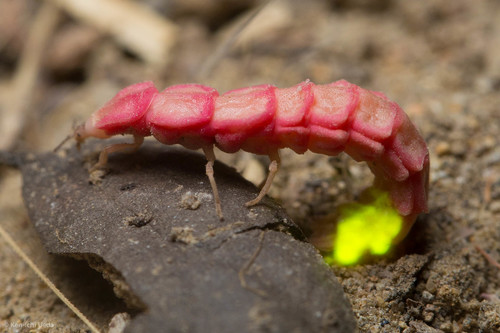
As larvae, P. pyralis live underground and feed on worms, slugs, and snails. Larvae go through multiple instars, or molting periods, as they grow. Because fireflies are extremely vulnerable during the larval stage, they evolved to produce light as an aposematic signal to ward off predators — this trait occurs even in species that do not remain chemiluminescent as adults, which P. pyralis does. At the end of the larval stage, P. pyralis develops into a pupa. After 1 to 3 weeks, it ecloses, or emerges as an adult. Adult common Eastern fireflies live for approximately another three weeks to two months, during which they use their light to attract mates.