About Phoronopsis californica Hilton, 1930
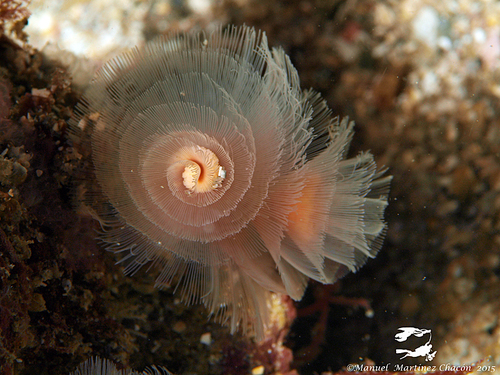
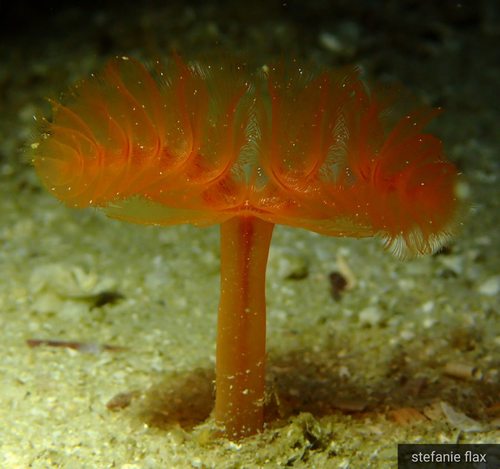
Phoronopsis californica lives inside a stiff, sand-encrusted tube embedded in sandy or muddy sediment. The tube can reach up to 250 millimetres in length, measures 3 millimetres wide at its open end, and has a diameter twice that size at its midsection. The opposite, sealed end of the tube has a bulge. Just below the lophophore, the worm's feeding organ, at the collar, the worm has a distinct marked involution of the epidermis, a trait that distinguishes the genus Phoronopsis. When fully extended, the worm can reach 450 millimetres in length, with a diameter of up to 5 millimetres. Its body colour varies, but is most often orangish-brown, and its lophophore is typically red, orange or green. The lophophore holds around 1,500 tentacles, each approximately 2.5 millimetres long. These tentacles are arranged in a pair of helicoid whorls that have four to seven coils. Only the tentacles project from the seabed, making them the only part of the animal that is normally visible. They can be retracted back into the tube when danger is present, or when the animal is no longer submerged. Phoronopsis californica is found in shallow coastal waters of California, and in temperate European waters near Spain, Portugal and Madeira. It lives alone, and builds its tube in soft sediments ranging from mud to coarse sand. It occurs on the lower shore and in the neritic zone down to a depth of thirty metres. In the Mediterranean Sea, it is found growing in association with the seagrass Cymodocea nodosa.