About Phoronis australis Haswell, 1883
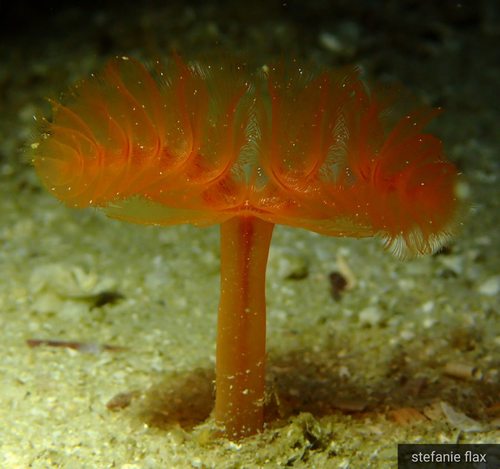
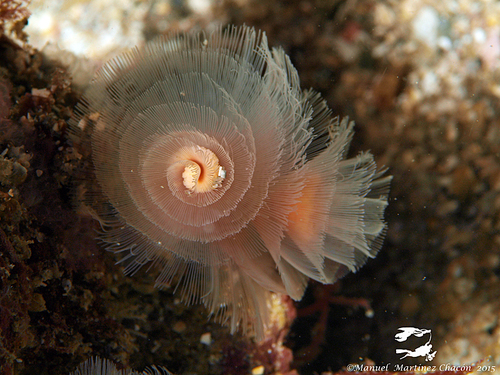
When fully extended, Phoronis australis reaches a length of about 200 mm (8 in) and has a diameter of approximately 2 to 5 mm (0.1 to 0.2 in). Its lophophore forms a double spiral, with up to one thousand tentacles on each side. The body color of this species is variable, and can be pink, dark red, or black. Phoronis australis is native to the Indo-Pacific region and the southeastern Atlantic Ocean. It has been present in the Mediterranean Sea since the 1990s, and likely entered through the Strait of Gibraltar, as the earliest Mediterranean records came from Spain. In the Mediterranean, it is most commonly associated with the tube-dwelling anemone Cerianthus membranaceus, with an average of eight individual Phoronis australis found on each anemone's tube. It has also been recorded living independently in the Mediterranean, where it inhabits muddy coarse sand and attaches its tube to the seagrass Posidonia oceanica. Phoronis australis secretes a chitinous tube that it can retreat into when disturbed. When associated with anemones, its tube attaches to the much larger tube of a tube-dwelling anemone that lives in shallow, sheltered water embedded in soft sediment, and multiple Phoronis australis may associate with a single ceriantharian anemone. This species extends its lophophore to feed on planktonic particles. When living with anemones, it gains protection from the anemone's tentacle canopy, and is alerted to danger when the anemone reacts to disturbance by withdrawing into its tube. The anemone most likely gains no benefit from this inquiline relationship. Phoronis australis is a hermaphrodite. Its embryos are initially brooded in two clumps on mucus threads produced by nidamental glands. The planktonic actinotroch larvae eventually settle and undergo metamorphosis. This species can also reproduce asexually through transverse fission.