About Phormium tenax J.R.Forst. & G.Forst.
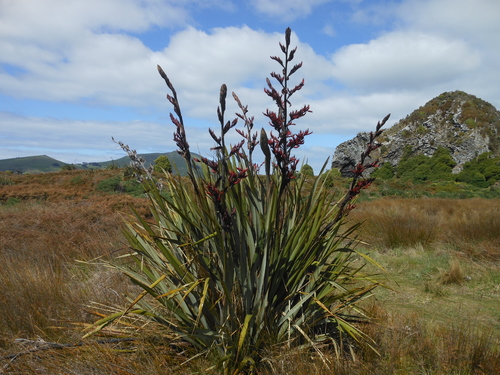
Phormium tenax J.R.Forst. & G.Forst. is called flax in New Zealand English, harakeke in Māori, New Zealand flax outside New Zealand, and New Zealand hemp in historical nautical contexts. It is an evergreen perennial plant native to New Zealand and Norfolk Island. It is both an important fibre plant and a popular ornamental plant. It grows as a clump of long, straplike leaves up to two metres long, and produces a much taller flowering shoot that bears dramatic yellow or red flowers. Despite sharing the common name "flax", harakeke belongs to the monocot genus Phormium and produces leaf fibre. True flax (used to make linen) belongs to the rosid genus Linum and produces bast fibre that comes from the plant's stem, and the two species are extremely distantly related evolutionarily. The fibre of Phormium tenax has been widely used ever since Māori first arrived in New Zealand; it was originally used in traditional Māori textiles, and after European arrival it was also used for rope and sail making until at least World War II. It is an invasive species in some Pacific Islands and in Australia. The leaf blades of the plant contain cucurbitacins, which are poisonous to some animals, and some of these compounds are among the bitterest substances tasted by humans. In ecology, the jumping spider Trite planiceps lives predominantly in the rolled-up leaves of this species. Phormium tenax acts as a coastal cover plant and is associated with key habitats, including the breeding habitat of the endangered yellow-eyed penguin. Prior to European contact in New Zealand, New Zealand flax was one of the most commonly used fibres for weaving, thanks to its wide availability and long leaf strands. Harakeke can be woven in its raw state to create open-weave items, where the para (waterproof epidermis of the plant) is kept intact. Alternatively, it can be processed to leave only the fibrous muka, which is used for close-weave objects. The broad length of harakeke leaves lets weavers create a variety of strip lengths, making the plant suitable for a wide range of object types and sizes. In pre-European Māori society, people maintained dedicated plantations of flax, which was their most important textile. Harakeke leaves were cut close to the base, then split and woven. Different preparation methods produced materials suitable for different uses: a hardy, flat, thick-woven material used for items like kete (baskets) and mats, and a fibrous twine used to make rope and finely woven cloaks. Harakeke strips can be bleached by boiling them with hot stones, but dyeing the fibre is difficult because of the water-resistant para layer. It can be dyed using paru, an iron-rich mud. The hapine technique, where a knife or shell is run across the fibre to remove moisture without breaking the surface layers, makes harakeke more flexible and reduces shrinkage. In traditional Māori society, Phormium tenax had many uses, and became the main material for weaving after aute (paper mulberry), the traditional Polynesian fabric tree, failed to thrive in New Zealand's climate. Most traditional uses have largely fallen out of common practice, though interest and use of traditional materials is growing in modern Māori art and craft. The two most common forms of flax used in traditional craft are stripped, dried leaves as broad bands (used to weave kete flax baskets), and scraped, pounded, washed leaves processed into muka fibre, which is used for tāniko weaving to make soft, durable fabric for clothing. Flax is also used as a decorative and structural element in tukutuku, the decorative panelling found inside Māori wharenui (meeting houses). Before the 1930s Great Depression, which destroyed the commercial flax industry, Europeans made two major attempts to breed Phormium tenax for improved fibre production. The first was led by Wellington-based Leonard Cockayne around 1908, and the second by Massey-based John Stuart Yeates in the late 1920s. More recently, research led by Xiaowen Yuan at Massey University has investigated composite materials made from Phormium tenax flax fibre to improve the performance of supercapacitors. New Zealand flax was cultivated on Saint Helena from the late 1800s to around 1966, to produce string and rope for export. While the plants still grow on the island today, the industry has ended, and the plants are now considered an ecological problem there.