About Pholis ornata (Girard, 1854)
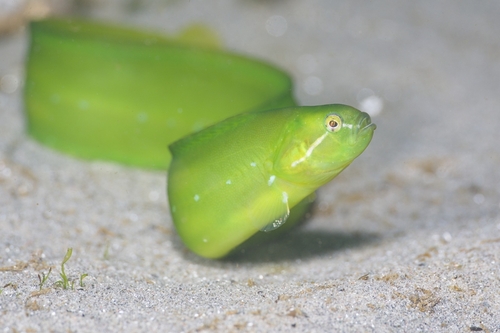
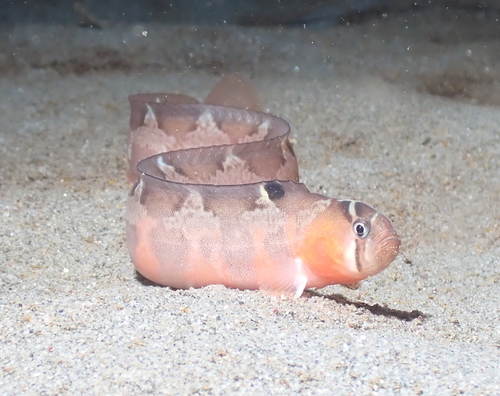
Pholis ornata, commonly called the saddleback gunnel, has an elongated body that is compressed laterally. Its snout is roughly one-fifth the length of its head. This species has a maximum published total length of 30 cm (12 inches).
The saddleback gunnel's dorsal fin is notably long, averaging 86.2% of the fish's total body length. It holds between 74 and 79 spines: most spines are short and thick, but the first four to six spines at the front of the fin are thinner. The anal fin has 2 spines plus 35 to 38 soft rays, with two thick spines located at its start. The caudal fin is rounded, connected to both the dorsal and anal fins via webbing. The pelvic fins are very small.
Twelve or thirteen blackish-brown saddle-shaped markings run along the back of the fish. The body is red-brown, speckled with gray, and the scales on the body are arranged in an orderly pattern. No scales cover the head, and no scales are found past the postorbital canal and occipital commisura. Light and dark streaks radiate outward from the eyes. The dorsal fin has 11 to 16 thin, vertical white stripes, while the anal fin has up to 14 light spots. The head's lateral system works through a series of pores: two nasal, six suborbital, six postorbital, three occipital, four mandibular, and five preopercular.
Teeth of the saddleback gunnel are mid-sized, tapered, and elongated in shape. The upper jaw typically holds 24 to 26 teeth, while the lower jaw holds 18 to 20 teeth. Lower jaw teeth are often more numerous than upper jaw teeth, and the lower jaw develops a second row of teeth; large individuals can have over 50 total teeth. Total tooth count varies by geographic location.
The distribution of the saddleback gunnel extends from Vancouver Island in the north to Santa Barbara County, California in the south, along the northeast Pacific west coast, covering the coasts of Washington, Oregon, and California. Canadian populations are recorded to migrate to these more southern areas during cold winter months. The species can be found at depths between 0 and 50 meters (0 to 164 feet), living in intertidal and subtidal coastal areas and estuaries, on muddy substrates among seaweed and seagrass. It is also known to occur in Hardy Bay and Brooks Peninsula near Vancouver Island, and in the Straits of Georgia and Juan de Fuca in summer, where it inhabits beach eelgrass beds.
On the U.S. west coast, saddleback gunnels are common in estuaries, including Oregon's Yaquina Bay, where they share nearshore communities with species like Pacific staghorn sculpins and rockfishes. In Yaquina Bay, this species occurs in the upper, freshwater-influenced parts of the bay. Eelgrass beds are a key habitat for Pholis ornata, acting as both nurseries and living areas for the fish.
Saddleback gunnels are rarely seen by divers, as they spend most of the day hiding in structures and are wary even at night. Seasonal patterns affect their distribution and populations. In Yaquina Bay and other Oregon coastal estuaries, population density is higher from late winter to early spring, due to increased numbers of post-larval individuals occupying rocky intertidal areas. In summer, the intertidal vertical range of the population shifts downward: fish occupy lower intertidal zones and are not found in higher intertidal zones at this season. By summer, fish reach up to 45 mm in length. Warming temperatures and longer day length in warm seasons lead to increased growth of vegetation in plant beds and mudflats, supporting large P. ornata populations in these plant beds through the summer. When algal growth is low in Yaquina Bay, P. ornata will settle on intertidal rocks. In fall and winter, the fish return to also occupy higher intertidal zones. The species readily hides in seasonally available vegetation that provides cover, and seasonal growth of these plant beds on mudflats supports the fish's movement between zones.