About Pholiota flammans (Batsch) P.Kumm.
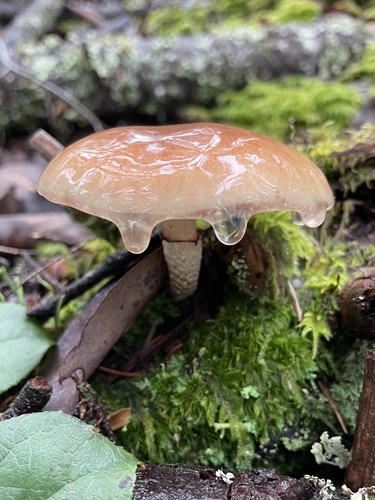
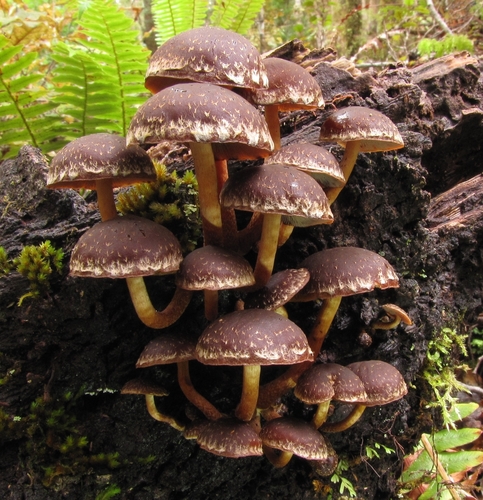
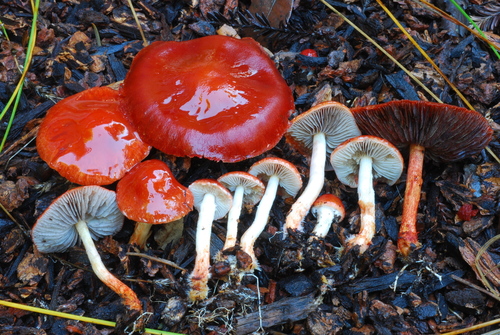
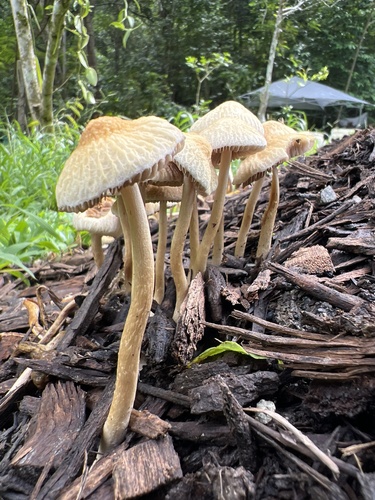
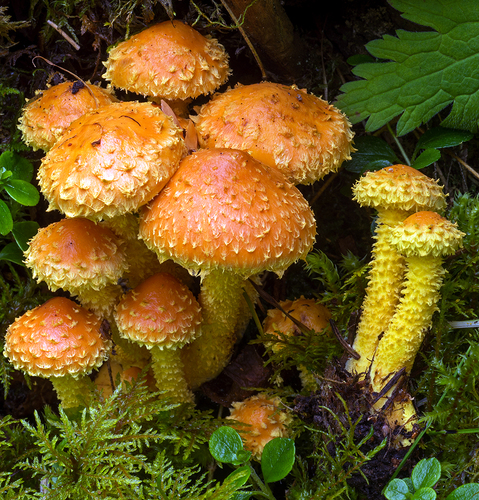
Pholiota flammans (Batsch) P.Kumm. often has a striking appearance. The cap starts out round, becomes convex, and finally flattens as it ages. Its surface ranges from bright yellow to orange, and is covered with triangular scales (squamules) arranged in concentric rings. The cap surface is dry, matt, and felt-like, and may lose its scales in wet conditions. The cap margin remains slightly curved inwards. The yellow gills are crowded, attached to the stem, and have a notch at the point of attachment to the stem. Immature specimens have a bright yellow partial veil that extends from the edge of the cap to the stem. As the cap expands and flattens with age, the partial veil tears, leaving a faint ring around the stem. The cylindrical stem is either straight or curved, and is covered in yellow squamules below the ring. The base of the stem, which is typically more orange than the upper portion, is firmly attached to the dead wood that this fungus grows from. The section of the stem above the ring has little to no protuberances. The flesh is firm, full, yellow, and does not change color when bruised or injured. Mature fruit bodies have the following dimensions: cap diameter up to 8 cm (3 1⁄8 in), stem up to 12 cm (4 3⁄4 in) tall, and between 0.4 to 1 cm (1⁄8 to 3⁄8 in) thick. As the fruit body matures, the gills darken to cinnamon brown after spore release. The spore print is brown to rust. As a saprobic species, P. flammans grows exclusively on dead and decaying stumps and trunks of coniferous trees. Fruit bodies appear either in tufts or singly, from summer to autumn. This fungus has a wide geographical distribution across boreal and temperate regions, and its abundance ranges from common to rare depending on the region. It can be found throughout Europe, from the British Isles to Russia, and throughout North America, in southern Canada and the United States. This species has also been collected in Asia, including India and China.