About Pholiota communis (Cleland & Cheel) Grgur.
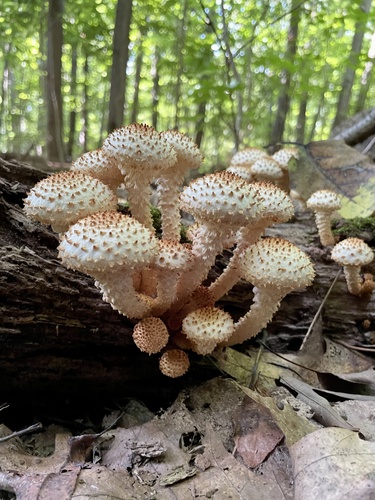
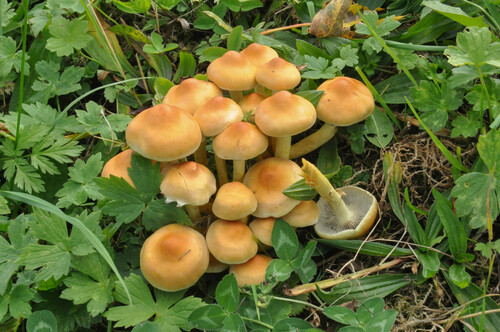
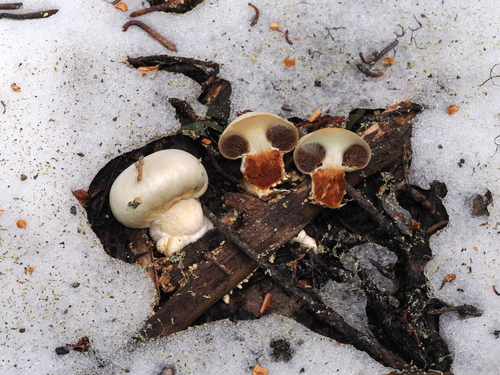
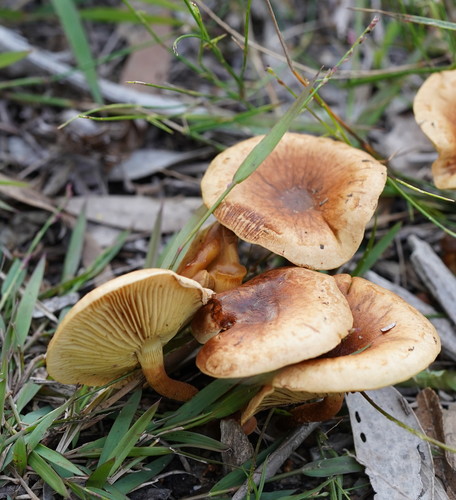
This fungus, Pholiota communis, produces fruit bodies whose caps reach up to 7.5 cm (3.0 in) in diameter. Caps are convex when young and flatten as they mature. The cap surface is orange-brown with flat brown scales; it is initially viscid (sticky) before becoming dry. The gills on the underside of the cap are bright yellow when young, fading to a duller tan at maturity. The lower half of the stem is covered in brown scales. The spore print is dark brown. Spores are elliptical in shape and measure 8.5 by 5.5 micrometres. The flesh of this fungus has no distinct taste. Pholiota communis fruit bodies appear between April and July. It has been recorded in the Mount Lofty Ranges, Kuitpo Forest, Beck Valley near Inman Valley, Bangham, and Kalangadoo in South Australia; in New South Wales; and in the Yarra Valley in Victoria. It grows in eucalypt and pine forests, typically in caespitose clumps or tufts, or in groups within leaf litter. It can occasionally grow a few feet up the trunks of trees. Documented associated tree species include messmate stringybark (Eucalyptus obliqua) and white ironbark (Eucalyptus leucoxylon).