About Pholidoscelis fuscatus (Garman, 1887)
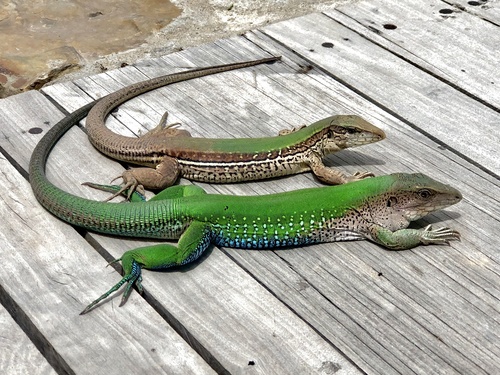
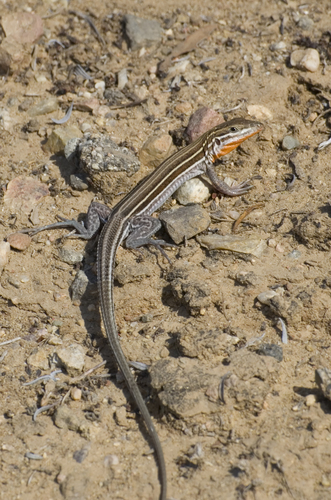
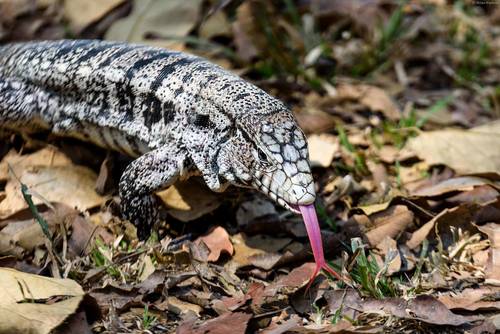
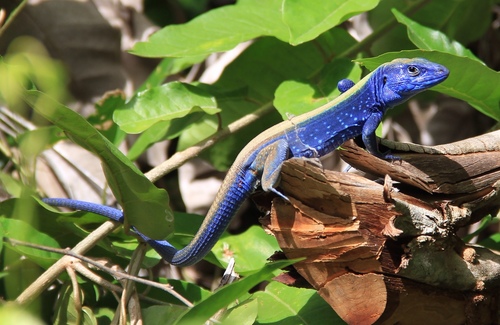
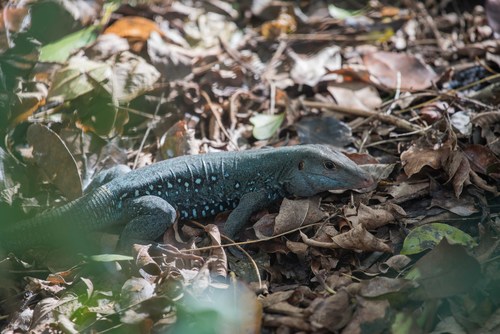
Adults of the Dominican ground lizard, Pholidoscelis fuscatus, have bright blue spots on their flanks and inner thighs. Their dorsal surface is gray or sometimes reddish-brown, flecked with black. Their ventral surface is pale blue, while the throat and chest are dark blue-gray. The species shows very little sexual dichromatism; only males tend to be more uniformly blue-gray. Adult males can reach a snout-vent-length (SVL) of up to 200 mm, and females reach up to 154 mm SVL. Their tails are approximately the same length as their snout-vent body. Adult males also have broader heads and broader jowls than females. Juveniles look markedly different from adults, and cannot be sexed through simple observation. Juveniles are coppery-brown overall, with a dark brown lateral stripe on each side bordered by yellow lines. These stripes have yellow flecks and spots, which turn blue as the lizard matures. Juveniles are often confused with adults of two other lizard species found in the same habitat, Gymnophthalmus pleii and Mabuya mabouya, because all three are fast moving and share similar coloration and size. These two species can be distinguished from juvenile Dominican ground lizards by their shinier skin and less differentiated, snake-like head and body. The Dominican ground lizard is found only on the island of Dominica, which is one of the few Lesser Antillean islands that has kept its original reptile and amphibian fauna over the last 200 years. It is one of two lizard species endemic to Dominica; the other is the Dominican anole. It is fairly common across the island, and inhabits dry coastal woodland, coastal scrub, littoral woodland, and cultivated land below approximately 300 m elevation. Dominica's coastal woodlands are noted as unusually favorable for reptiles, with one of the highest recorded biomass values for terrestrial reptile populations. In this environment, the mean population density of Dominican ground lizards is estimated at 379 individuals per hectare. The species' range is expanding to higher elevations as more of Dominica's rain forest is cleared for agricultural development. Dominican ground lizards are heliothermic, and are usually only seen during the hottest part of the day. They are primarily terrestrial, but have been observed climbing trees to heights over 1.5 m, possibly to hunt; this climbing behavior has also been recorded in at least two other lizard species. Males reach sexual maturity at 94 mm SVL, while females reach sexual maturity at 105 mm SVL. They do not have a restricted breeding season, and reproduce year-round. It is estimated that they lay two or three clutches of eggs each year. Each clutch contains approximately four eggs, and clutch size tends to increase as the female grows larger.