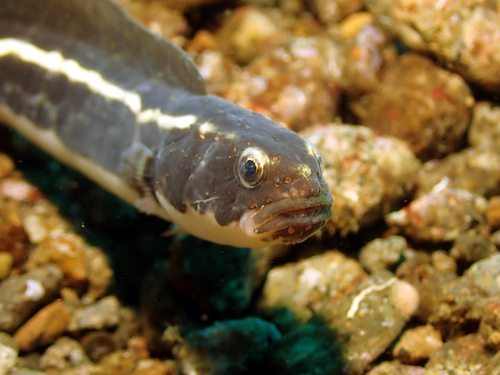
About Pholidichthys leucotaenia Bleeker, 1856
This small eel-shaped fish reaches a maximum length of 34 cm (13 in). Juveniles resemble the venomous striped catfish Plotosus lineatus, with black bodies and a single white dorsal stripe. As the fish matures, this stripe develops into white convict-style barring or spotting in adults. Pholidichthys leucotaenia inhabits shallow lagoons and coastal reefs, ranging from the Philippines to the Solomon Islands. It is commonly found in schools under ledges or around coral heads; these schools swim in such tight formations that they appear to be a single organism. The species occasionally enters the aquarium trade, where it is known to disrupt all but the most stable tank structures. DNA analysis confirms that this species is not a blenny or a goby, and instead belongs to the separate family Pholidichthidae. In the Solomon Islands, researchers led by Eugenie Clark observed juveniles emerging from holes in the seafloor and adjacent coral reefs. By day, these juveniles swim up to 50 m (165 feet) from their home burrows to feed on plankton, and all return to the burrows at the end of the day — a remarkable and unique behavior for larval fish. In captivity, fry grow approximately 1 cm (0.5 in) per month during their first year, and gradually change color as they develop. While juvenile fish are out feeding, adult parents eject mouthfuls of debris from the shared burrows. Parents can collect and spit out as much as 3 kg (6.6 lb) of sand from the burrow hole in a single day. Research has found that burrows form a maze of tunnels and chambers with a total length of around 6 m (20 ft). At night, juvenile fish dangle from the roof of the tunnels by thin mucous threads attached to their mouths. Even though adults can reach almost 34 cm (13 in) in length, they never leave the burrow tunnels to feed. Adults frequently take juveniles into their mouths and spit them out again. Inspections of adult stomachs have found only green slime.

