About Phoenicurus phoenicurus (Linnaeus, 1758)
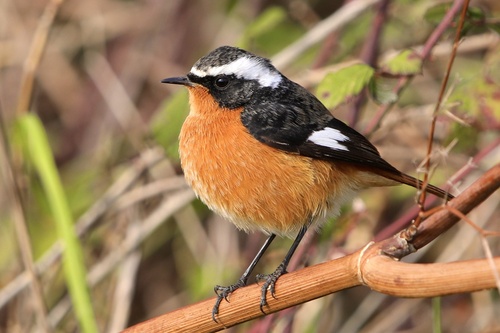
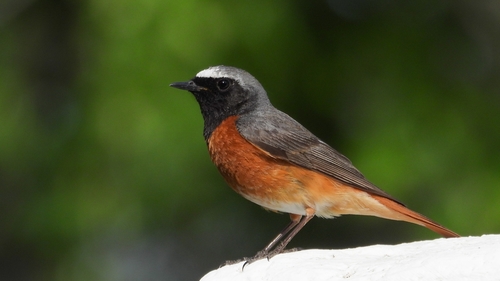
The common redstart (Phoenicurus phoenicurus) shares many habits and behaviors with the European robin. Both species have a similar general posture and chat-like behavior, and the common redstart matches the European robin’s length of 13–14.5 cm, though it is slightly slimmer and lighter, weighing 11–23 g. Its distinctive orange-red tail, which gives the species and related redstarts their name ("start" is an old word for "tail"), is frequently quivered. Among common European birds, only the closely related black redstart (Phoenicurus ochruros) has a tail of a similar color. Summer plumage male common redstarts have slate-grey heads and upperparts, except for the rump and tail, which are orange-chestnut, along with the flanks, underwing coverts, and axillaries. Males have a white forehead, and black sides of the face and throat. The two central tail feathers are dark brown, while all other tail feathers are bright orange-red. For the nominate subspecies Phoenicurus phoenicurus phoenicurus, the wings are grey-brown, but adult male Phoenicurus phoenicurus samamisicus have white outer webs on their remiges that form a pale to whitish wing patch. The orange color of the flanks fades to almost white on the belly. Males have black bills and legs. In autumn, pale feather fringes on the body obscure the male’s bold colors, giving him a washed-out appearance. Female common redstarts are grey-brown on their upperparts, and buff-white to light orange on their underparts. Most females have a whitish throat, but some (likely older) females have a dark bib, and some even look similar to males. Many female P. p. samamisicus have a light wing patch matching the male’s feature, though the patch is much less prominent. Common redstarts prefer open mature birch, oak, or (particularly in the northern part of their breeding range) conifer woodland, which has high horizontal visibility and little shrub and understorey growth, especially with old enough trees that provide nesting cavities. They also use other habitats including orchards, villages, parks, and old gardens in urban areas. In Britain, the common redstart is found primarily in upland areas that have not been heavily affected by agricultural intensification. The species builds nests in cavities such as natural tree holes, so dead trees or trees with dead limbs are beneficial, and they commonly use nestboxes. They also prefer areas with high moss and lichen cover. In England, where the species has declined by 55% over the past 25 years, grants are available for supporting the species from the Forestry Commission through England's Woodland Improvement Grant (EWIG), and from Natural England's Environmental Stewardship Scheme. It is a very rare breeding bird in Ireland, with between one and five pairs breeding in most years, nearly all of these in County Wicklow. The common redstart is a summer visitor that breeds across most of Europe and western Asia, as far east as Lake Baikal, and also in northwestern Africa in Morocco. It winters in central Africa and Arabia, south of the Sahara Desert but north of the Equator, ranging from Senegal east to Yemen. It is a widespread breeding bird in Great Britain, particularly in upland broadleaf woodlands and hedgerow trees, while it is very localized in Ireland and may not breed every year. The first males arrive in early to mid April, usually a few days before females. Females lay five or six light blue eggs during May, and a second brood may be raised in midsummer in the southern part of the breeding range. Common redstarts depart for their wintering grounds in Africa between mid-August and early October. They often feed similarly to flycatchers, making aerial sallies to catch passing insects, and most of their diet is made up of winged insects. The main contact call across Central Europe is a rising, slightly disyllabic huid. In southern Italy and across the range of the subspecies P. p. samamisicus, this call is replaced by a monosyllabic heed. In Italy, this heed call may be rising or constant in pitch; in P. p. samamisicus, the call is always constant and resembles the slightly higher-pitched contact call of the collared flycatcher Ficedula albicollis. A third contact call variant occurs on the Iberian peninsula, and in Siberia, both huid and heed calls may be combined. All call variants are regularly used alongside ticking alarm calls. The male's song is made up of soft, melancholy strophes 1–2 seconds long, divided into three parts: an introduction, a repetitive section, and a more variable final section. This structure is very consistent across the breeding range of the nominate subspecies, but it is more variable in P. p. samamisicus, where the introduction only rarely consists solely of a clear whistle matching that of nominate P. p. phoenicurus. Common redstarts are sometimes parasitized by common cuckoos. Surprisingly, redstart chicks do not experience negative effects from sharing a nest with a cuckoo chick, and the presence of a cuckoo may even be beneficial for redstart nestlings. The large cuckoo chick changes thermoregulation within the nest, and effectively acts to "brood" the redstart nestlings. Additionally, food provisioning may be better for redstart chicks in a mixed brood with a cuckoo.