About Phoebetria palpebrata (J.R.Forster, 1785)
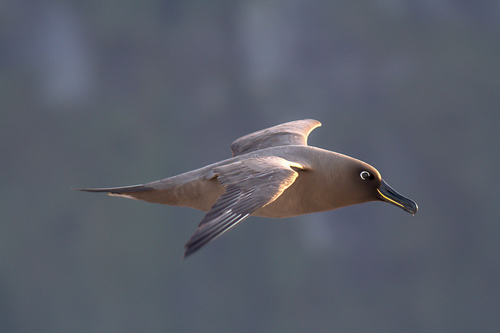
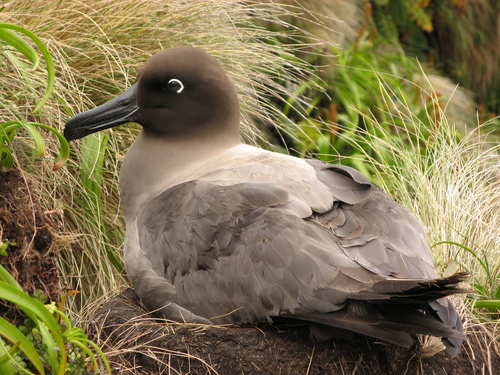
The light-mantled albatross, scientific name Phoebetria palpebrata (J.R.Forster, 1785), is mostly sooty-brown or blackish, with darker coloring on the head. Its upperparts, from the nape to the upper tail-coverts, are paler, ranging from grey to light grey, and are palest on the mantle and back. Its plumage coloration has been compared to the coloring of a Siamese cat. Thin crescents of very short grey feathers, located behind the eyes, partially circle the eyes. The bill is black, with a blue groove and a greyish-yellow line along the lower mandible, and measures about 105 mm (4.1 in) long. Males and females are similar in size: average body length is 79 to 89 cm (31–35 in), average wingspan is 183 to 218 cm (72–86 in), and average weight is 2.5 to 3.7 kg (5.5–8.2 lb).
This albatross has a circumpolar pelagic distribution across the Southern Ocean. Its range spans from the pack-ice surrounding Antarctica—the southernmost recorded individual was found at 78°S in the Ross Sea—to about 35°S, with occasional sightings further north along the Humboldt Current. It breeds on multiple subantarctic islands, including Prince Edward Island, Marion Island, the Crozet Islands, Amsterdam Island, St. Paul Island, the Kerguelen Islands, Heard Island, Macquarie Island, Campbell Island, the Auckland Islands, the Antipodes Islands, and South Georgia. It also breeds on at least one island in the maritime Antarctic: King George Island at 62°S. Except when breeding, it lives entirely in marine habitats, and forages from the edges of the Antarctic pack-ice to around 40°S. During the breeding season, foraging individuals stay closer to their nest sites.
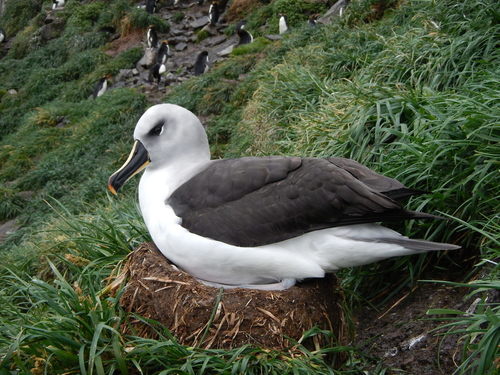
This species breeds in loose colonies, small groups, or occasionally as solitary breeders. Nests are built on vegetated cliff ledges or steep slopes, in spots sheltered from the prevailing westerly winds. Each nest is a low mound of peat and mud, 15 to 30 cm (5.9–11.8 in) high and 45 to 55 cm (18–22 in) wide at the base, with a cupped hollow at the top. It includes some plant material and is lined with grass. Around October or November, a single egg is laid, and the egg is not replaced if it is lost. Both sexes incubate the egg alternately, in shifts that can last anywhere from one or two days up to nearly a month. The total incubation period is 65 to 72 days. Hatching takes 3 to 5 days, and occurs in December or January. After hatching, adults brood the chick in shifts for around 20 days. After this period, the chick is left alone in the nest while adults go foraging; adults return to feed the chick by regurgitation every 2 to 3 days. The entire nestling period, from hatching to fledging in May or June, lasts 140 to 170 days. Breeding pairs form long-term committed bonds that can last for decades, and these bonds are renewed through complex courtship displays at the breeding site. On average, light-mantled albatrosses begin breeding when they are 8 to 15 years old. After starting breeding, they breed biennially, and successfully fledge a chick roughly every five years. They can breed until at least 32 years old, and can live 40 years or longer.