About Phoebetria fusca (Hilsenberg, 1822)
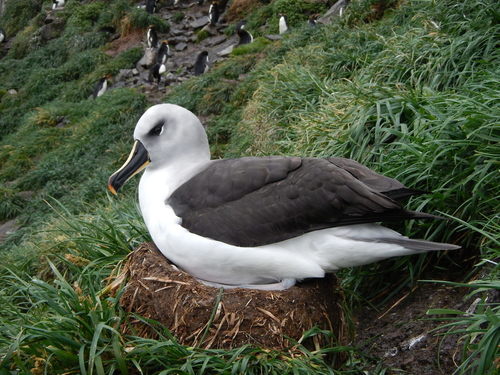
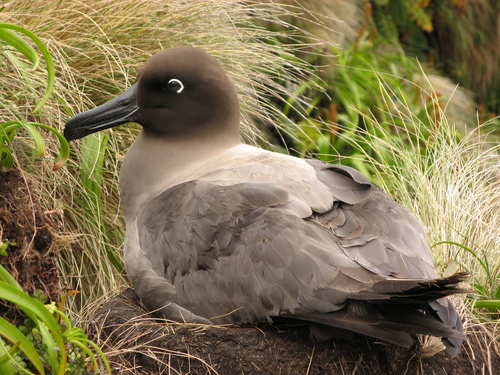
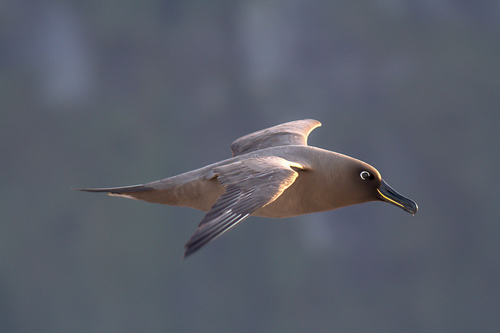
The sooty albatross has the scientific name Phoebetira fusca (Hilsenberg, 1822). It is a medium-sized albatross that measures around 85 cm (33 in) from head to tail, with a 2 m (6.6 ft) wingspan. The average body mass of adult individuals is about 2.5 kg (5.5 lbs), and males are heavier than females. Individual sooty albatrosses have plumage that ranges in color from sooty-brown to sooty-black, and their head, and sometimes their tail, is typically darker than the rest of the body. A white ring surrounds almost the entire eye, only leaving out the inner corner. The beak is mostly uniform glossy black, with a yellow to orange line running along the lower jaw. Juvenile and immature sooty albatrosses look nearly identical to adults after they lose their down feathers. The sooty albatross occurs in the South Atlantic Ocean, the southern Indian Ocean, and the Southern Ocean between Australia and South America; it has not been recorded in the South Pacific Ocean between Australia and South America. Its range limits are roughly 20°S to the north, 65°S to the south, 160°E to the east, and 75°W to the west. This albatross breeds on islands in the southern Atlantic Ocean (Gough Island and the Tristan da Cunha group) and the southern Indian Ocean (Prince Edward Island, Marion Island, the Crozet Islands, Amsterdam Island, and the Kerguelen Islands). Generally, sooty albatrosses forage across deep ocean waters. Non-breeding adults rarely travel outside their native oceans but have a wider foraging range, breeding adults forage within 600 km (370 mi) of their breeding sites, and juvenile birds are typically restricted to subtropical waters. The sooty albatross is a marine bird that spends most of its non-breeding period out on the ocean. When it is time to breed, individuals return to land, and they will return to breed at the same site for life. The sooty albatross is a biennial breeder, which means it usually breeds every other year. The only exception is when a mated pair fails to successfully raise a chick; in that case, the pair will attempt to breed again the following year. The breeding season runs from June of one year to May of the next, and unlike many other albatrosses, the sooty albatross does not lay replacement eggs if an initial egg is lost. During the breeding season, sooty albatrosses usually form colonies of up to 50 mated pairs, though they occasionally nest as a single isolated pair. Like many other albatross species, sooty albatrosses form lifelong mating partnerships, and they almost always return to the exact same nesting site each breeding season. Mated pairs collect local materials including grass, mud, and moss to build a short nest with a central indentation. Nests are usually built on cliffs or steep slopes to make arrival and departure easier. Mated pairs are very protective of their nest, and they use threat displays to defend their nest and assert their territory. Pairs usually arrive at their breeding colony or nesting site in mid-July, and lay their egg between mid-September and the end of October. After laying, the pair incubates the egg for roughly 70 days until it hatches in mid-January of the next year. Parents brood their chick for around three months, taking turns incubating and foraging, before they leave the nesting site. Chicks stay at the breeding site until the end of May, when they are ready to fledge.