About Phoebastria nigripes (Audubon, 1839)
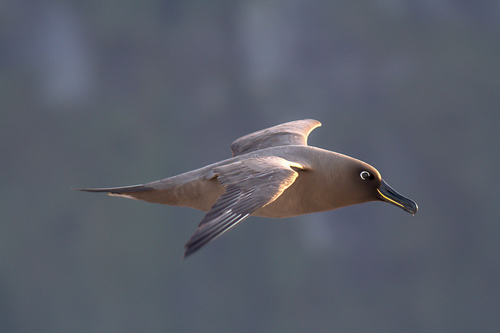
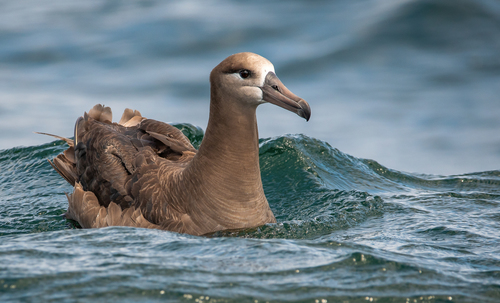
The black-footed albatross, scientifically named Phoebastria nigripes (Audubon, 1839), is a small member of the albatross family, though it is still large when compared to most other seabirds. This species has almost entirely black plumage. Some adult individuals have white undertail coverts, and all adults have white markings around the base of the beak and below the eye. As black-footed albatrosses age, they gain additional white plumage at the base of the beak. Their beak and feet are also entirely dark. This species only has a single plumage type. Adults measure 68 to 74 cm (27–29 in) in length, have a wingspan of 190 to 220 cm (6.2–7.2 ft), and weigh 2.6–4.3 kg (5.7–9.5 lb). Males are larger than females, with an average weight of 3.4 kg (7.5 lb) compared to the female average of 3 kg (6.6 lb). Black-footed albatross is one of three albatross species that live in the Northern Hemisphere, alongside Laysan albatross and the rare short-tailed albatross; all other albatross species range from the Equator southward. There are at least 12 known breeding locations for this species, but 97.5% of the total population breeds colonially on the isolated Northwestern Hawaiian Islands, from Kure Atoll to Kaula Island, including sites like Laysan, Midway, and the French Frigate Shoals. Small populations are found on the Japanese islands of Tori Shima, Bonin, and Senkaku, and off the Mexican coast, primarily on Isla Guadalupe. This species is no longer found at Iwo Jima, Agrihan, Taongi Atoll, Marcus Island, Wake Island, and Johnston Island. At sea, the species' range changes with the seasons: it strays farther from breeding islands when chicks are older, or when the birds do not have chicks. It uses large areas of the North Pacific, feeding from Alaska to California and Japan, and prefers the northeastern Pacific Ocean. Its breeding and feeding range overlaps heavily with the other two northern albatross species, though those two species range further north into the Bering Sea than the black-footed albatross does. Black-footed albatross have occasionally been sighted in the Southern Hemisphere.