About Phodilus badius (Horsfield, 1821)
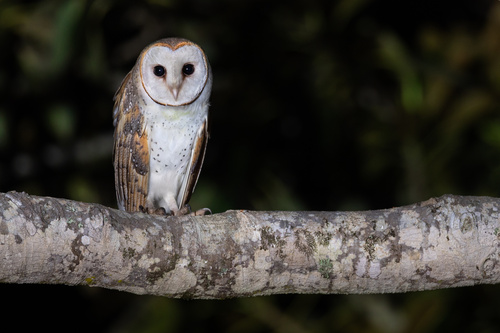
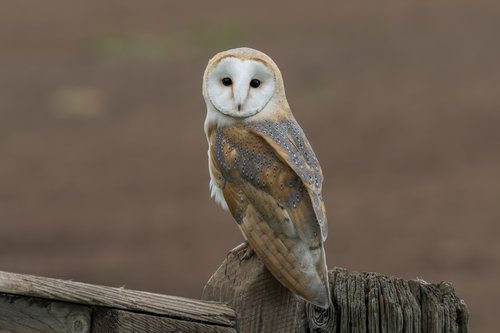
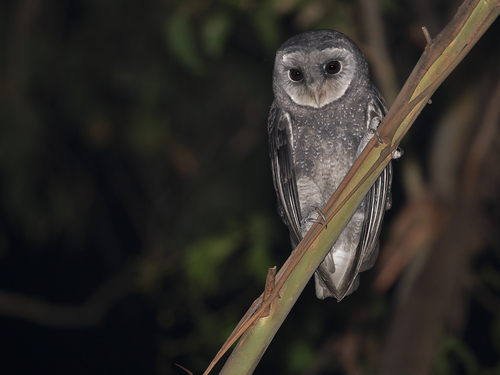
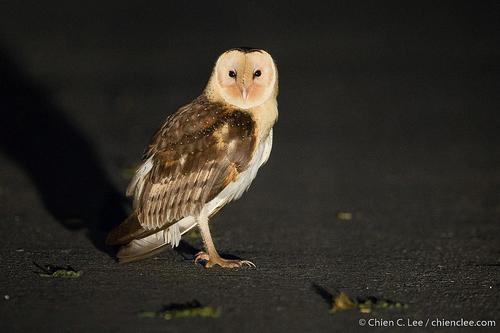
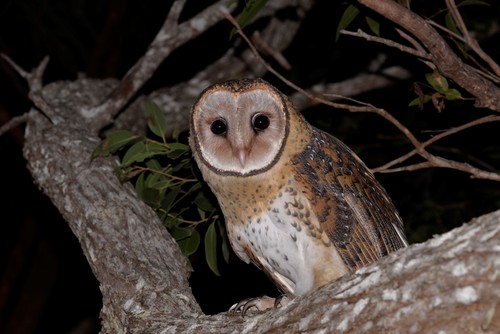
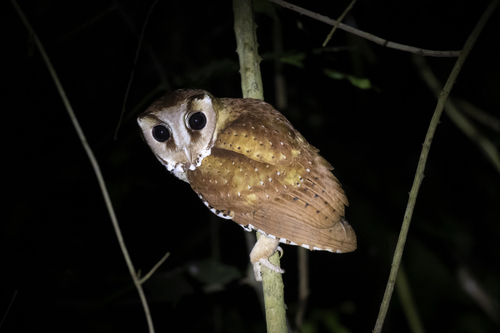
Phodilus badius (Horsfield, 1821), commonly called the Oriental bay owl, is a small owl species distinguished by its highly angular head. The upper back and top of its body are deep chestnut, while the underparts and belly are cream and tan. It has large, striking black eyes that stand out due to the color contrast of its facial plumage. Small and typically upright in posture, it is very hard to spot across its wide range of habitats. This species has notable vocal versatility; it can produce hoots, screams, and high-pitched whistled songs. Its songs are usually made up of four to seven melancholic whistles, lasting 2 to 8 seconds total, with pitch rising slightly toward the end. When moving between locations, it sometimes alternates these songs with a shorter repeated whistle that sounds like kleet-kleet-kleet or kleek-kleek-kleek. Adults measure 22.5–29 cm in total body length, with a wing length of 172–237 mm and tail length of 168–239 mm. Their weight ranges from 255–308 g, and females are usually larger than males. The Oriental bay owl is distributed across Nepal, Sikkim, Assam, Nagaland, Manipur, Burma, and Thailand, extending east to southern China and south through the Malay Peninsula to the Greater Sundas. Scattered populations also occur across India, Thailand, Singapore, the Philippines, and other parts of Southeast Asia, where it inhabits woodland, plantations, and mangrove swamps up to 2,200 meters (7,220 feet) in elevation. Little is widely known about this species even within its native range. It occurs in tropical moist forests and tropical wet evergreen forests across Southeast Asia, with confirmed rare sightings recorded between February and June 1998 at 1,040–1,050 m above sea level in Sengaltheri, Tamil Nadu, India. In India, the species has two separate population areas: one in the northern Himalayan foothills and the surrounding region, and a southern population in the southern Western Ghats spanning Kerala and Tamil Nadu. It is also found in Indian evergreen forests and wetland areas of Sri Lanka. The Oriental bay owl is a solitary, nocturnal bird. Its elevation range spans from 200 m up to 2,300 m depending on location. In the Himalayan foothills it typically occurs between 200–1,000 m, but human-caused destruction of many lowland foothill forests has pushed some populations into higher elevation montane forests up to 2,300 m. The total population size is small, so the species remains poorly studied.