About Phocoenoides dalli (True, 1885)
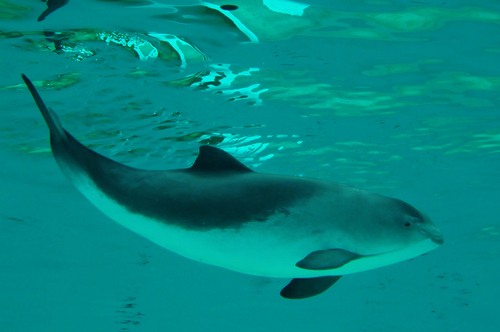
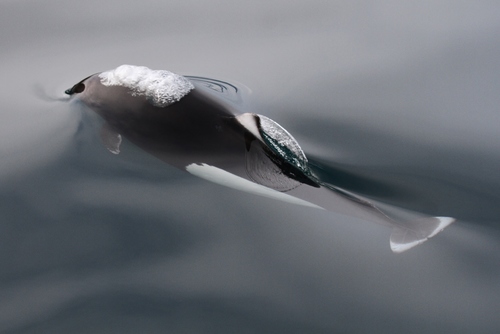
Dall's porpoise (scientific name Phocoenoides dalli (True, 1885)) can be easily told apart from other porpoises and cetaceans that share its range. It has a wide, robust body, a comparatively small head, and no distinct beak. Its flippers are located toward the front of the body, and a triangular dorsal fin is positioned mid-body. While its color patterns vary widely, Dall's porpoises are mostly black, with white to grey patches on the flank and belly, and pale 'frosting' on the dorsal fin and the trailing edge of the fluke. This is the largest living porpoise species: adults grow up to 2.3 metres (7 ft 7 in) long and weigh between 130 and 220 kilograms (290–490 lb). Sexual dimorphism is visible in body size and shape; mature males are larger, develop a deeper caudal peduncle, and have a dorsal fin that angles significantly further forward than that of females. Newborn Dall's porpoise calves are grey in color, with no frosting on their flippers and flukes, and measure approximately 100 cm at birth. Calves of both sexes grow at similar rates at first, but starting at around two years old, males grow faster than females. External sexual maturity is correlated with body length, which is usually reached between 3 and 5 years of age. Average maximum sizes vary between populations: on average, females reach 210 cm and males reach 220 cm, though males in the southern Okhotsk Sea can grow as long as 239 cm. Two distinct color morphs have been documented: the dalli type and the truei type. The truei morph, which is only found in the western Pacific, has a white belly patch that extends further forward across the body than the patch of the dalli morph. Dall's porpoises are restricted to the North Pacific: their range extends from California to the Bering Sea and Okhotsk Sea in the eastern Pacific, and south to the Sea of Japan in the western Pacific. They have been recorded as far south as Scammon's Lagoon in Baja California during periods of unseasonably cold water. Dall's porpoises generally prefer cold waters with temperatures below 18 °C (64 °F). While they are mostly an offshore species, they also live in deeper coastal waters, near submarine canyons, and within fjords.