About Phoca largha Pallas, 1811
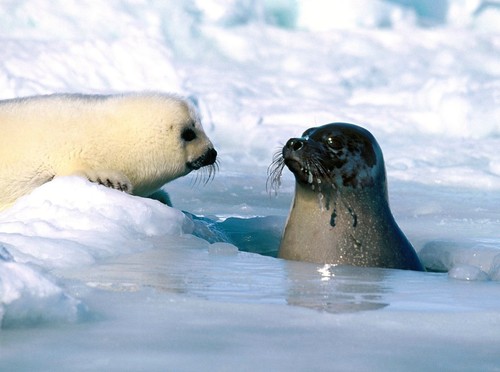
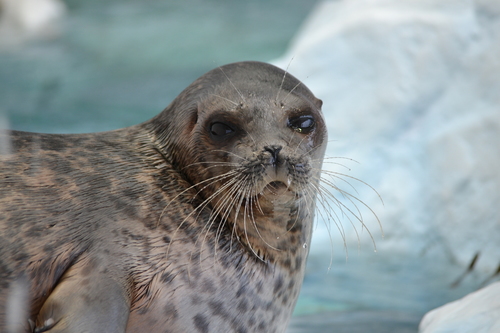
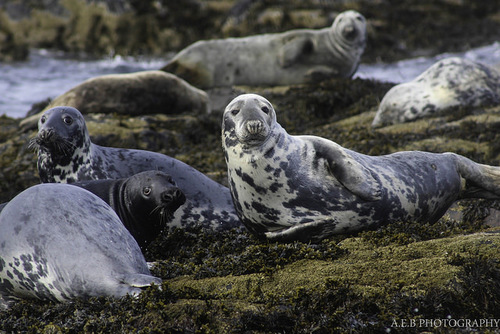
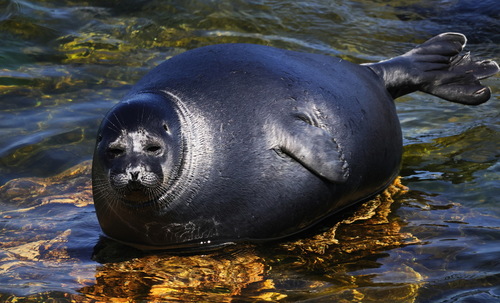
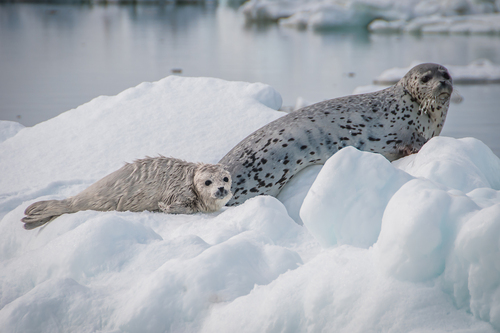
The spotted seal, with the scientific name Phoca largha Pallas, 1811, belongs to Phocidae, the family of "true seals". It is intermediate in size compared to other true seals. Mature adults of both sexes generally weigh 82–109 kg (180–240 lb) and measure 150–210 cm (59–83 in), which is roughly the same size as a harbor seal or ribbon seal. Males and females differ very little in size or shape. The spotted seal has a round head with a narrow, dog-like snout, a relatively small body, short thrust-providing flippers that extend behind the body, and small front flippers that act as rudders. Its dense fur ranges in color from silver to gray to white, and is covered entirely over the body with dark, irregular spots against this lighter background. Where the spotted seal’s range overlaps with the harbor seal’s, such as in Bristol Bay, Alaska, the two species can be easily confused. Like harbor seals, spotted seals have 34 teeth. Spotted seals live in arctic and sub-arctic waters. During the breeding season, they most often occupy the outer areas of ice floes, and tend to avoid living within dense drift ice. In summer, they inhabit the open ocean or nearby shorelines. There are three distinct recognized populations of spotted seal. The Bering Sea population numbers around 100,000 individuals, and ranges across the western Bering Sea near Kamchatka, the Gulf of Anadyr in Russia, and the eastern Bering Sea in Alaskan waters; this is the only population found in the United States. A second population of around 100,000 seals breeds in the Sea of Japan and the Sea of Okhotsk. The third, smaller population of around 3,300 seals lives further south, in Liaodong Bay, China and Peter the Great Bay, Russia. There is also an additional small population of 300 spotted seals that inhabits waters off Baekryeong Island, far north of the west coast of South Korea. Spotted seals are relatively shy and hard for humans to approach. They are generally solitary outside of specific seasons, but become gregarious and form large groups when they haul out onto ice floes (or onto land if ice is unavailable) during pupping and molting seasons. The largest of these groups in Alaska form at Kasegaluk Lagoon in the Chukchi Sea, near Cape Espenburg in Kotzebue Sound, and on sandbars and shoals in Kuskokwim Bay, where groups can number several thousand individuals. Spotted seals reach sexual maturity around four years of age. Their breeding season runs from January to mid-April, with pup births peaking in mid-March. Gestation lasts 10 months, and spotted seals are believed to be annually monogamous. During breeding season, they form "family" groups made up of one male, one female, and their new pup. Newborn spotted seals average 100 cm (39 in) in length and 12 kg (26 lb) in weight. Pups are weaned six weeks after birth. The maximum recorded lifespan of the spotted seal is 35 years, and few individuals live beyond 25 years of age. When foraging, spotted seals can dive to depths of up to 300 m (980 ft), and feed on a wide variety of ocean prey. Juveniles feed primarily on krill and small crustaceans. Adults feed on a range of fish including herring, Arctic cod, Pacific cod, pollock, and capelin, alongside mollusks and crustaceans. Spotted seals do not appear to vocalize often, and little is currently known about their vocalizations overall. They seem to vocalize more frequently when gathered in molting groups. When approached in these groups, they produce a variety of sounds including growls, barks, moans, and roars. Satellite tracking of the Yellow Sea spotted seal population has shown that these seals migrate more than 3,300 km (2,100 mi).