About Phlyctenactis tuberculosa (Quoy & Gaimard, 1833)
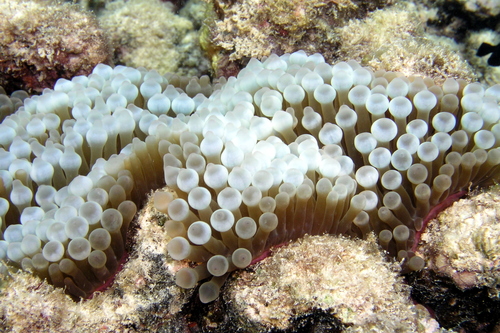
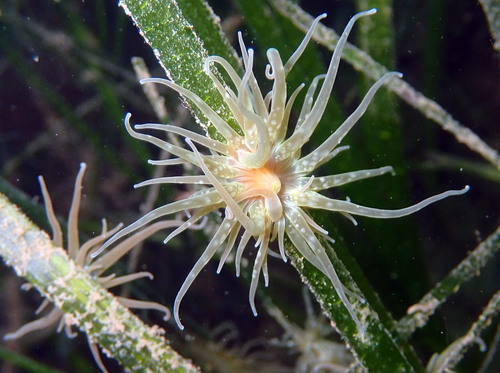
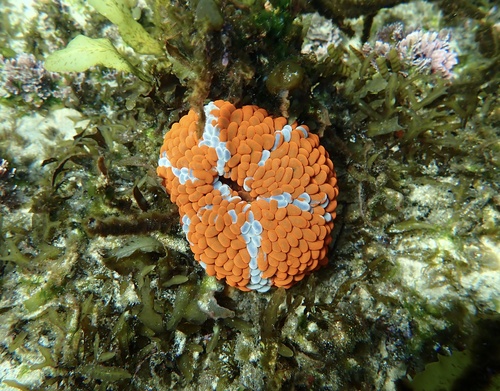
This anemone, Phlyctenactis tuberculosa, is covered in bubble-like sacks and shows a wide range of coloration: its body can be brownish orange, mauve, light grey, or brown, while its tentacles are a lighter shade, which may be pale yellow, grey, brown, or orange-yellow. It reaches a maximum diameter of 15 centimeters (6 inches), and its column can grow up to 25 centimeters (10 inches) long. During the day, it stays bundled together, giving it an appearance similar to a ball of baked beans. This is a nocturnal species that inhabits moderately exposed areas and sheltered reefs, found at depths down to 35 meters. It attaches itself to rock, seagrasses, and kelp, but is capable of detaching from its pedal disc, and is commonly found drifting across the sea floor. It creeps across the seabed using its basal disc to move, and at night it climbs sea grasses or algae to reach a better position to intercept floating prey. This species is distributed across Western Australia, Victoria, South Australia, New South Wales, Tasmania, and New Zealand.