About Phleum bertolonii DC.
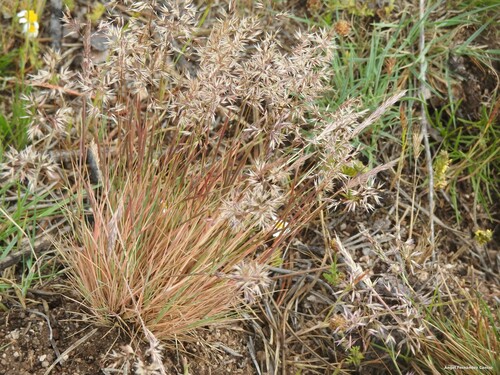
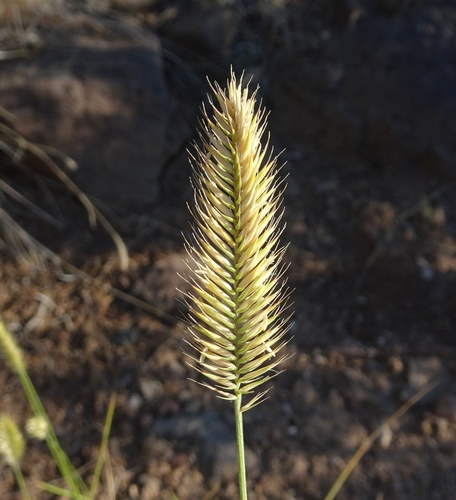
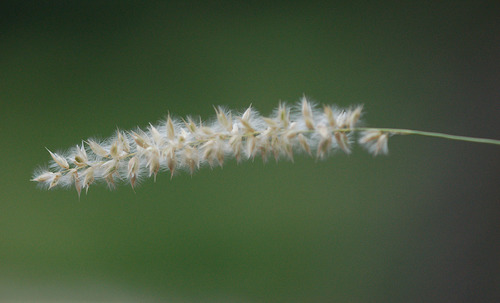
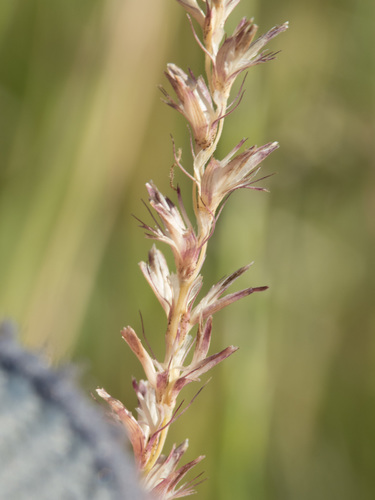
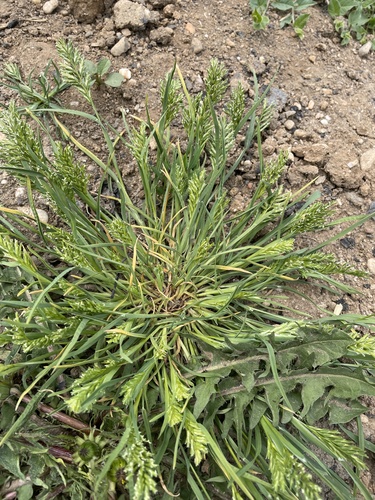
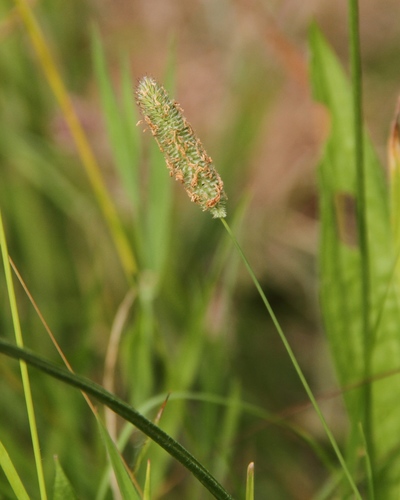
Phleum bertolonii DC., commonly called timothy, grows 48–150 cm (19–59 in) tall. Its leaves can reach up to 43 cm (17 in) long and 1.3 cm (0.5 in) broad; the leaves are hairless, rolled rather than folded, and their lower sheaths turn dark brown. This species has no stolons, rhizomes, or auricles. Its flowerhead is 70–152 mm (2.75–6 in) long and 6.4–12.7 mm (0.25–0.5 in) broad, covered in densely packed spikelets. It flowers from June to September, with pink stamens. Its ligule is short and blunt. Timothy grows well in heavy soil, and is resistant to cold and drought, allowing it to grow in dry upland or poor sandy soils. When growing in pastures, it tends to be outcompeted by more competitive grasses, and it grows slowly after being cut. Timothy was unintentionally introduced to North America by early settlers. It was first described in 1711 by John Hurd from specimens growing in New Hampshire. Hurd named the grass hurd grass, but around 1720 a farmer named Timothy Hanson began promoting its cultivation as hay, and the common name timothy has been used for the grass ever since. It has now become naturalized across most of the United States and Canada. It is commonly cultivated for cattle feed, and especially as hay for horses. It is relatively high in fiber, particularly when cut late. If cut earlier, it is a harsh, coarse grass that livestock rarely prefer. It is included as a standard component of grass hay mixes and provides quality nutrition for horses. Timothy hay is a staple food for domestic pet rabbits, guinea pigs, chinchillas, and degus, and often makes up the bulk of these animals' diets. Timothy hay is rich in long fiber, and its abrasive texture helps grind down animals' teeth to keep both the teeth and jaw healthy. Some caterpillar species, including the Essex skipper (Thymelicus lineola) and the marbled white (Melanargia galathea), use timothy as a food plant. Timothy also grows in roadsides and abandoned fields, and generally requires nutrient-rich soils. Plants survive through the winter. Dead, straw-colored flowering stems may remain standing for only a short time, and can be identified by their distinctive spike-like inflorescence. For medical use, timothy grass pollen allergen is used to treat hay fever.