About Phleocryptes melanops (Vieillot, 1817)
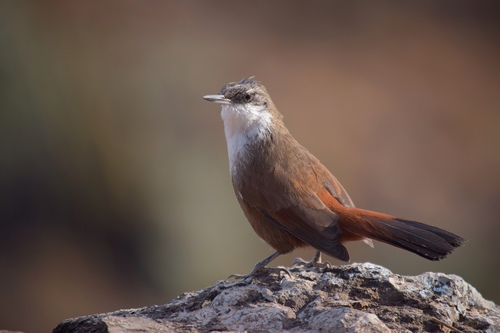
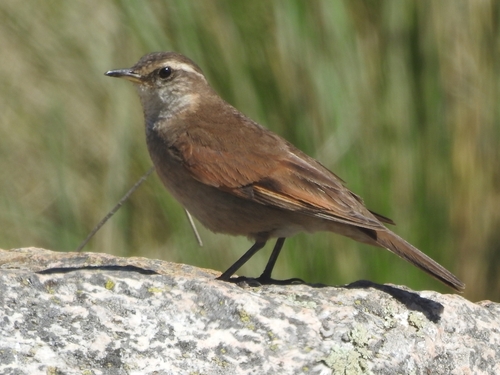
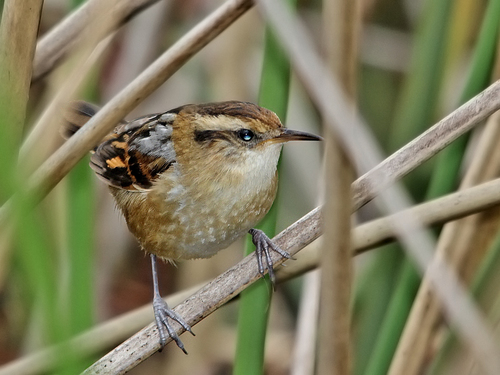
The wren-like rushbird (Phleocryptes melanops, first described by Vieillot in 1817) is a small furnariid bird. It measures 13 to 14 cm (5.1 to 5.5 in) in length and weighs 11 to 16 g (0.39 to 0.56 oz). Its plumage closely resembles that of the wholly unrelated marsh wren (Cistothorus palustris). The species has a longish, slightly decurved bill. The plumage of males and females is essentially alike, though females are slightly paler than males. For adults of the nominate subspecies P. m. melanops, the face features a wide buff supercilium, grayish lores, a dark brown band behind the eye, mottled dark brown ear coverts, and a buff malar area. Their crown is blackish with wide brown streaks, they have a buff-brown collar with few streaks, and their back is blackish with rich brown streaks and obvious white feather shafts. Their rump and uppertail coverts are also rich brown, with some blackish inclusions in the uppertail coverts. The innermost pair of their tail feathers are rich brown, and the rest are blackish brown with buffy to tawny tips; the last few centimeters of the innermost two pairs have bare shafts. Their wing coverts and wings are blackish; the wing coverts have wide chestnut tips, and the wings have chestnut and rufous edges that together form a wide band on the closed wing. Their underparts are white on the throat, buffy whitish on the breast and belly, dull brown on the sides and flanks, and a mix of tawny-buff and white on the undertail coverts. Their iris is brown to dark brown, their bill is blackish to dark horn (the lower mandible sometimes has a paler base), and their legs and feet are grayish horn. Juveniles are similar to adults but have narrow dark edges on their underpart feathers. Four subspecies are recognized, each with distinct traits: P. m. schoenobaenus is significantly larger than the nominate, has a longer bill, brighter upperparts, and whiter underparts. P. m. brunnescens has a paler but more heavily streaked crown than the nominate, a browner back, paler wingband, and paler, duller underparts. P. m. loaensis is similar to brunnescens, but has a somewhat darker and more chestnut wingband, and darker rump, sides, and flanks. The subspecies have separate geographic ranges: P. m. brunnescens is found on the coast of western Peru, between the Piura and Ica departments. P. m. schoenobaenus occurs in the Junín and Puno departments of central and southern Peru, the La Paz and Oruro departments of western Bolivia, and Jujuy Province in far northwestern Argentina. P. m. loaensis is found along the coast from southern Peru's Department of Arequipa south through northern Chile to the Antofagasta Region. The nominate subspecies P. m. melanops ranges from southern Brazil's Rio de Janeiro state south and west through Uruguay, central Chile, and most of Argentina; it occurs in northern Argentina and Paraguay during the non-breeding season. The wren-like rushbird inhabits freshwater and brackish marshes, plus the edges of lakes, all of which have emergent aquatic vegetation. It especially favors beds of Scirpus sedges. In terms of elevation, its range extends from sea level up to 4,300 m (14,100 ft).