About Phlegopsis nigromaculata (Orbigny & Lafresnaye, 1837)
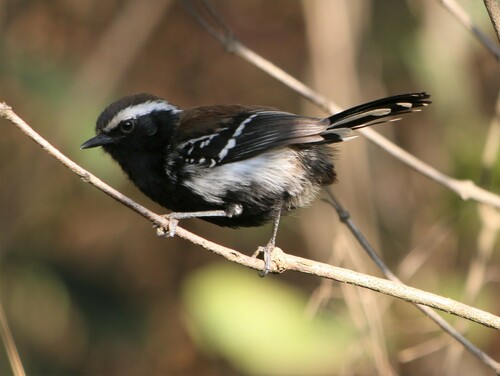
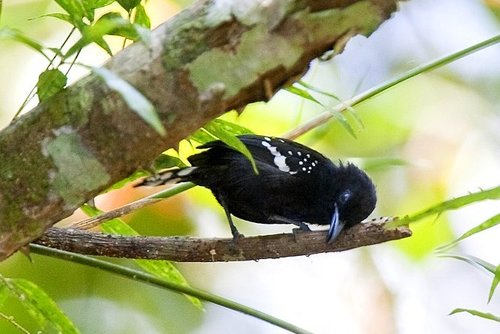
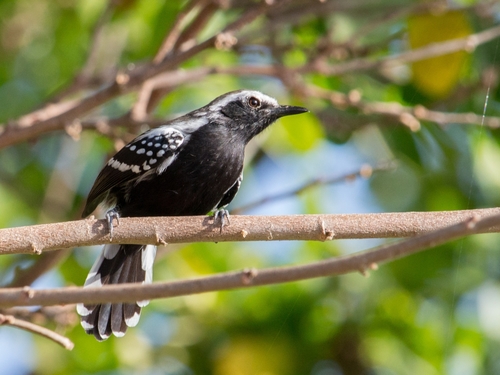
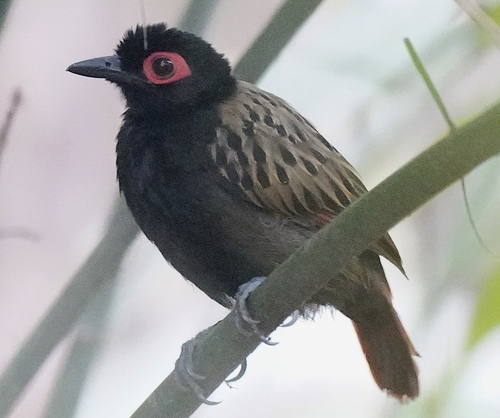
The black-spotted bare-eye, scientifically named Phlegopsis nigromaculata (Orbigny & Lafresnaye, 1837), is 16.5 to 18.5 cm (6.5 to 7.3 in) long and weighs 42 to 51 g (1.5 to 1.8 oz). Males and females have identical appearance: both have a large ring of bare red skin surrounding the eye. Adults of the nominate subspecies P. n. nigromaculata have black on the head, neck, throat, and upper belly. Their upperparts are light olive, with lengthwise oval black spots edged in pale yellowish olive-brown. Their flight feathers are cinnamon-rufous, and their tail is rufous-chestnut. Their underparts below the black breast are olive-brown, which becomes cinnamon-rufous closer to the tail. Subspecies P. n. confinis is smaller than the nominate, has a larger ring of bare facial skin, and is more heavily spotted. P. n. bowmani has brighter, more yellowish upperparts than the nominate, and its spots are wider than they are long. P. n. paraensis has a larger facial ring than the nominate; it has light rufous-brown upperparts, and its spots are smaller and rounder than the nominate's, with cinnamon edging. The subspecies of the black-spotted bare-eye are distributed as follows: P. n. nigromaculata ranges from south-central Colombia's Meta Department south through northeastern Ecuador, eastern Peru, and southwestern Amazonian Brazil into northeastern Bolivia; P. n. bowmani is found in south-central Amazonian Brazil and extends into northeastern Bolivia's Santa Cruz Department; P. n. confinis occurs in east-central Amazonian Brazil, from the Rio Xingu east to the rios Tocantins and Araguaia; P. n. paraensis is located in northeastern Brazil, in southern Amapá state and south of the Amazon, east from the Tocantins to western Maranhão state. The black-spotted bare-eye lives in humid evergreen forest in lowlands and foothills. In the western portion of its range, it is mostly found in várzea, and less commonly in terra firme and the transition zone between the two forest types. Further east, it occurs in all three of those forest types, as well as igapó. In terms of elevation, it can be found as high as 800 m (2,600 ft) in Peru, but only reaches 500 m (1,600 ft) in Colombia and 400 m (1,300 ft) in Ecuador; across most of Brazil, it occurs below 600 m (2,000 ft).