About Phlebopus marginatus Watling & N.M.Greg.
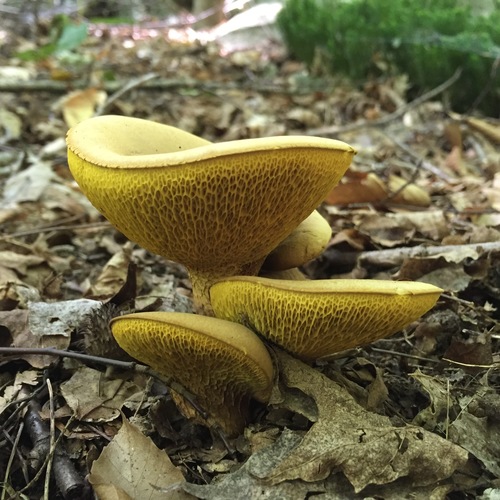
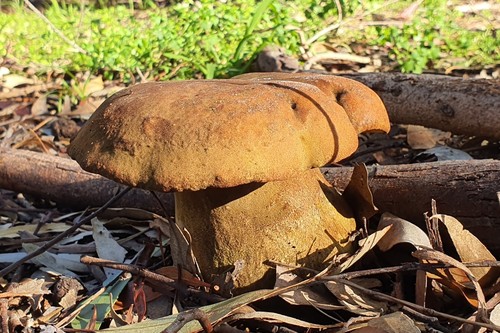
Phlebopus marginatus may be Australia's largest terrestrial mushroom, and its fruit bodies can grow to very large sizes. One specimen from western Victoria was recorded at 29 kg (64 pounds). John Burton Cleland reported finding specimens with cap diameters of 70 cm (28 in) that weighed over 32 kg (70 pounds), and there are also reports of specimens with caps over 100 cm (39 in) in diameter. The cap ranges from convex to flat, and occasionally has a depressed center. Its color is brown to olive, and it is covered in fine hair. Reports from different countries differ on whether the flesh changes color when cut or bruised: Western Australian records note no color change, while collections from New Zealand and Indonesia are reported to develop some bluish discoloration on bruising at the top of the stem. The spores of Phlebopus marginatus are yellow-brown. Mature specimens are very attractive to insects and are often infested by them. Phlebopus marginatus is a Gondwanan fungus and a pantropical species, found in Indonesia, Malaysia, Sri Lanka, Australia, and New Zealand, with related species found in South America. Within Australia, it has been recorded from the southeast of South Australia to New South Wales. It grows in eucalypt forests in Australia, and can appear any time after rain. Fruit bodies may grow alone, in groups, or even in fairy rings. It also occurs in rainforest in the Cooloola section of Queensland's Great Sandy National Park. In New Zealand, it may be associated with Nothofagus truncata. McNabb was uncertain if the species was introduced or indigenous to New Zealand, but suspected it was indigenous, as it was found in dense native forest near Rotorua; other New Zealand collections have been made around Auckland. It is common in Java and Sumatra. In China, it is found in Yunnan, Guangxi, and Hainan provinces. In China, it grows in association with Delonix regia (poinciana), Mangifera indica (mango), Coffea arabica (coffee), Citrus grandis (pomelo), Artocarpus heterophyllus (jackfruit), and Quercus (oak) species.