About Phintella piatensis Barrion & Litsinger, 1995
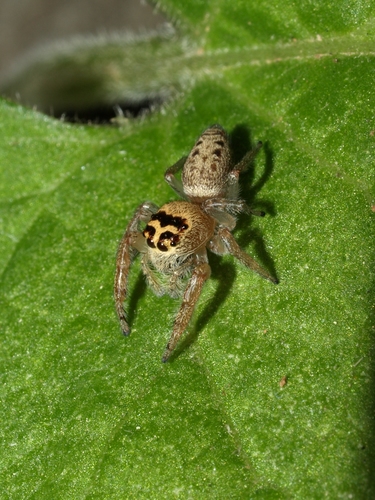
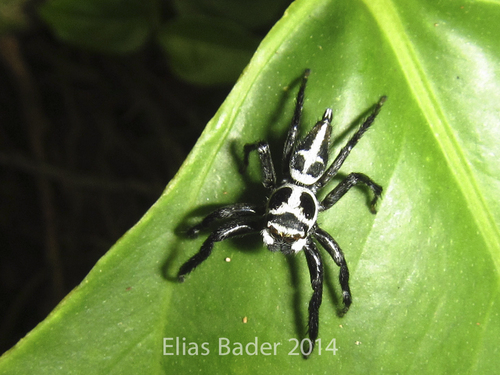
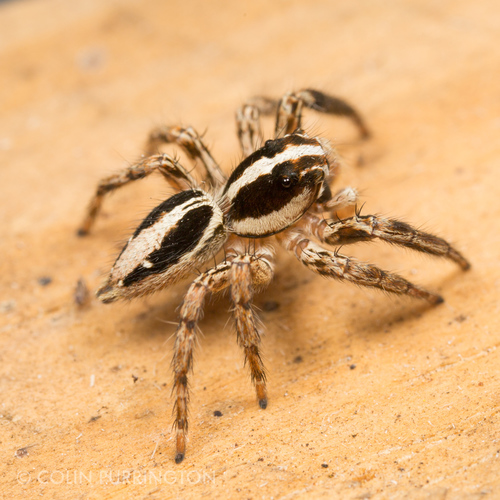
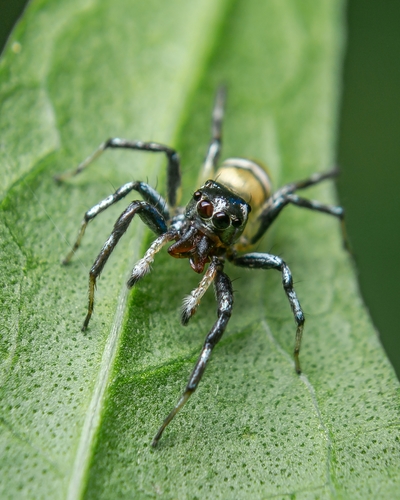
Phintella piatensis is a sexually dimorphic jumping spider species first described by Barrion & Litsinger in 1995. Females reach approximately 4.28 mm (0.169 in) in total body length. Their cephalothorax ranges in color from white to yellowish brown, with black spots surrounding the four posterior eyes and an additional pair of black spots located behind the fovea. Together with the two frontal eyes, this arrangement creates the appearance of 10 black spots across the cephalothorax. Female chelicerae are yellow-brown. The abdomen is ovoid and yellow-green, marked with a thick horizontal white band across its middle, flanked by two thinner grayish-black bands; the front of these two flanking bands is sometimes reduced to just two spots. All of these abdominal bands are typically bisected lengthwise by a narrow gap, and a single black spot sits at the posterior tip of the abdomen. Female legs are pale yellow, with brown spines and claw tufts, and follow the leg length formula 3412. Males are larger than females, measuring around 4.94 mm (0.194 in) in total length. The male cephalothorax has dark areas connected in the middle that surround its eyes, creating an appearance of six white spots. Two wide white bands also run along the sides of the posterior section of the male cephalothorax. Male chelicerae are long and light brown. The male abdomen is elongated, and shares a similar color pattern to females, though the pattern is typically more boldly colored. Male legs are darker than those of females, and follow the leg length formula 4132. This species is endemic to the Philippines.