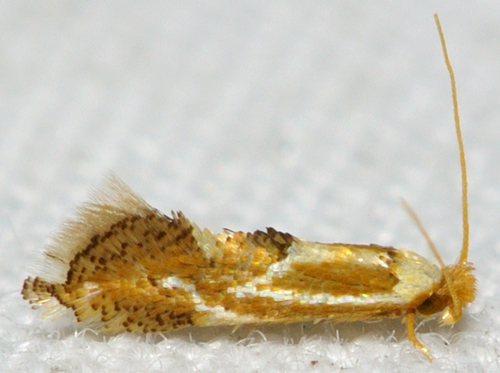
About Philonome clemensella Chambers, 1874
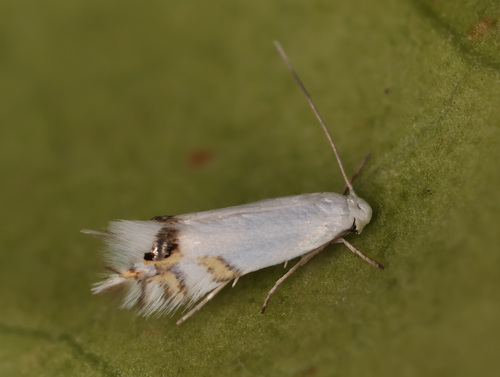
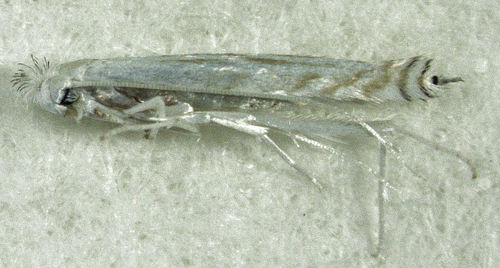
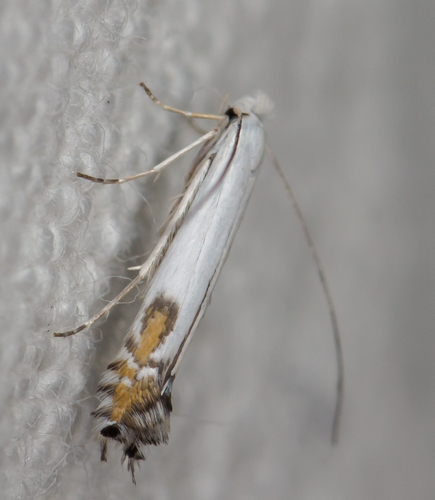
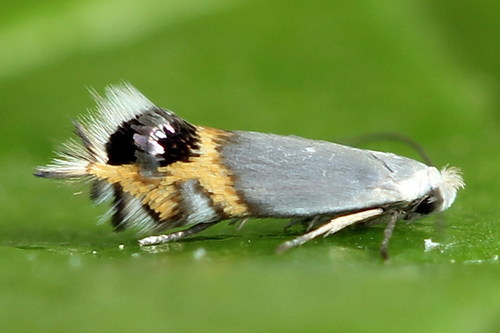
This species, Philonome clemensella Chambers, 1874, has forewings that measure 2.8 to 4.4 mm in length. The wings are narrow, and are typically folded around the abdomen when the moth is at rest. The forewing has an orange-brown base color. A diagonal white median line stops short of the costa, then turns to run parallel to the costa to connect to the white thorax. A diagonal white postmedial line starts wide at the costa, narrows as it extends inward, and stops before reaching the curved outer wing margin. Small clumps of black scales are found in four locations: posterior to the thorax, in a tuft near the median line, at the inner end of the postmedial line, and along the outer margin. This species occurs across an area stretching from Oklahoma and Minnesota in the west to Florida and Maine in the east, and also includes southeastern Canada. Older sources state that P. clemensella has been collected from hickory and linden trees. However, a recent review notes that these records are based on ambiguous label data from specimens held at the United States National Museum of Natural History. No additional observations of P. clemensella larvae on these trees have been reported. Adult P. clemensella have been recorded from April through November, with the majority of sightings occurring in June and July.