About Philolithus elatus
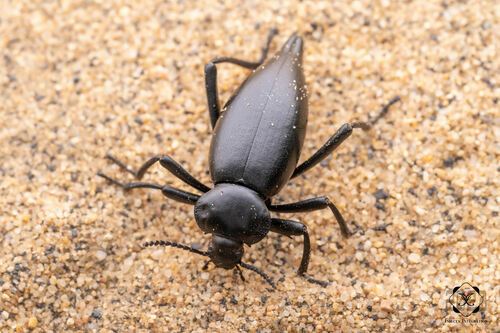
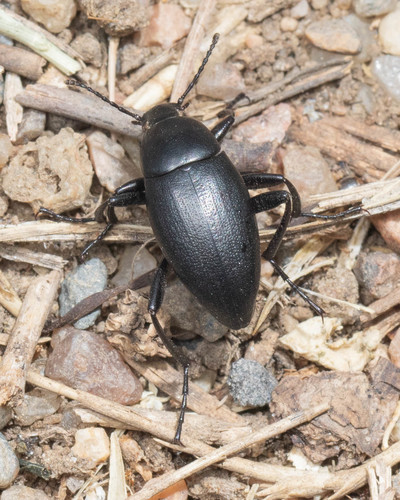
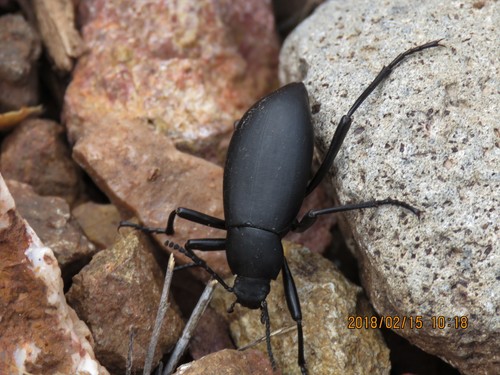
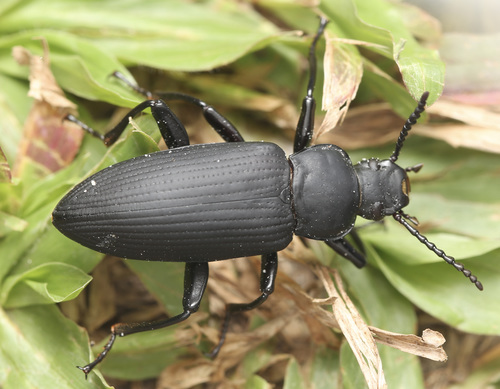
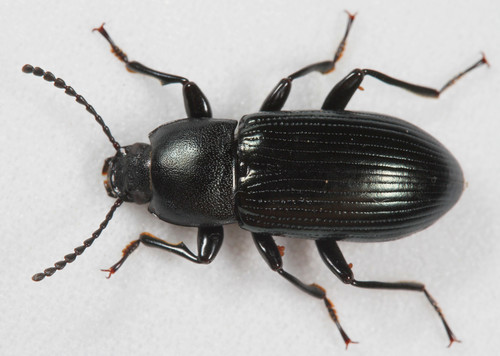
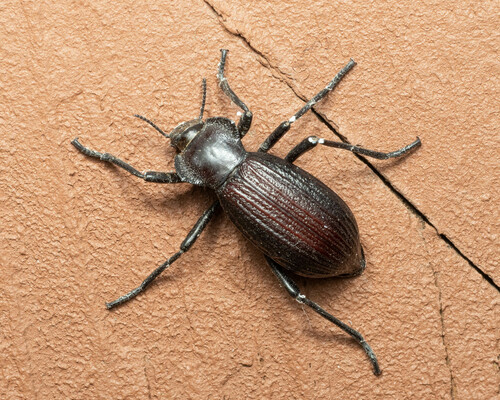
Philolithus elatus is a relatively large beetle in the Tenebrionidae family, measuring 21–35 mm (0.83–1.38 in) in length. It has a shiny black body; the surface of the pronotum (dorsal prothorax) is smooth and convex in the middle, while its margins are expanded, flex upward, and spotted with punctures. There is a distinct constriction between the prothorax and elytra, and physical traits vary by subspecies. For Philolithus elatus compar: elytral longitudinal ridges (carinae) are clear and well-defined, and lateral pronotum margins are not as strongly angled or reflexed as in P. e. difformis. For Philolithus elatus difformis: elytral carinae are clear and well-defined, and lateral pronotum margins are strongly angled and reflexed. For Philolithus elatus elatus: elytral carinae are poorly defined or not visible, elytral surfaces are rough, and lateral pronotum margins are strongly angled and reflexed. For Philolithus elatus infernus: elytral carinae are poorly defined or not visible, elytral surfaces are rough, and lateral pronotum margins are not as strongly angled or reflexed. This species is found in shrub savannas, pinyon-juniper savannas, shrub steppes, grassy steppes, grasslands, sagebrush steppe, and desert shrub areas across western North America. Each subspecies occupies a subset of this full range, with only modest overlap between them. The natural history of Philolithus elatus has not been extensively studied. Based on the ecology of other tenebrionid beetles, it is expected to be a detritivore that plays an important role in nutrient cycling. It is large, energy-rich, and readily eaten by predators, so it is expected to be a significant food source when present. Following observations of Philolithus densicollis, its larvae are expected to live underground for multiple years. Adult Philolithus elatus emerge in late summer and early fall, survive for about one month, and lay eggs on mounds of Pogonomyrmex ants.