About Philodendron jacquinii Schott
Philodendron jacquinii Schott, a member of the large genus Philodendron, shares key traits with most other species in this genus: its plants produce clear or resinous sap that is not milky, leaves are undivided into separate leaflets, and tiny flowers that are functionally either male or female grow on a finger-shaped spadix wrapped in a leafy structure called a spathe.
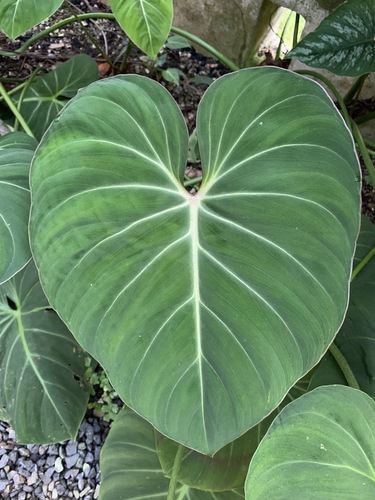
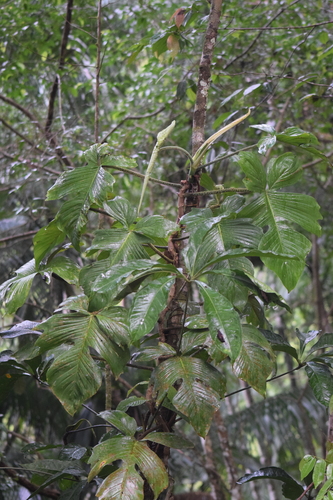
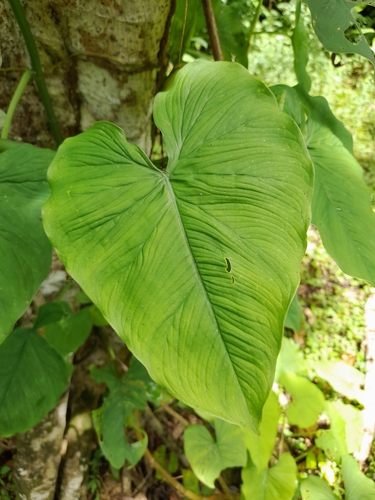
Distinguishing features that separate Philodendron jacquinii from similar Philodendron species include the following: Its stems grow loosely on tree trunks and low shrubs, sometimes hanging, and have a fine, uniform rough (asperous) texture when touched. Leaf blades reach a maximum size of 40 cm long and 28 cm wide (~16 × 11 inches), with a shape ranging from somewhat triangular to egg-shaped. The base of the blade has shallow to deep lobes: the backward-pointing lobes are rounded on young plants, and slightly pointed on older plants, giving the base a shape from heart-shaped (cordate) to nearly halberd-shaped (sub-hastate). Leaves drop off the plant during the dry season. Petioles (leaf stalks) grow up to 46 cm long (~18 inches), are round to slightly flattened in cross-section, and have a spongy texture.
The spadix and its surrounding spathe appear one at a time in leaf axils, growing on peduncles (stalks) up to 12 cm long (~4+3⁄4 inches). The spadix itself reaches up to 12.5 cm long (~5 inches). The spathe that wraps the spadix is red to purplish on the inside, is inflated, and splits open when its fruits reach maturity. Mature female reproductive structures (pistils) have an extended protrusion at their top. Ripe fruits of Philodendron jacquinii are red-orange.
This species is native to a range that extends from southern Mexico and Cuba through Central America, and in South America from Colombia to French Guiana.
Its documented habitats include: in Costa Rica, dry to rarely wet forests from sea level up to 1,300 meters in elevation; in Veracruz state, along Mexico's Gulf of Mexico coastal lowlands, tropical evergreen and semi-deciduous forests, as well as beaches and coastal dunes.
In the Yucatan Peninsula of Mexico, Philodendron jacquinii is reported to be used for magic in a religious context, and its latex is said to be toxic.