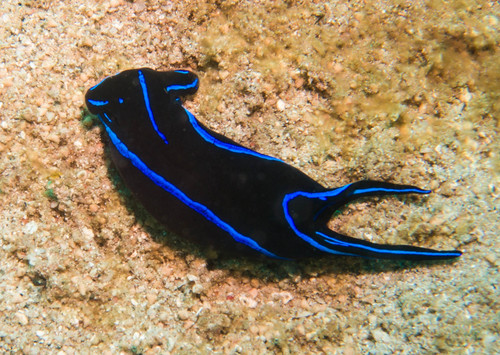
About Philinopsis speciosa Pease, 1860
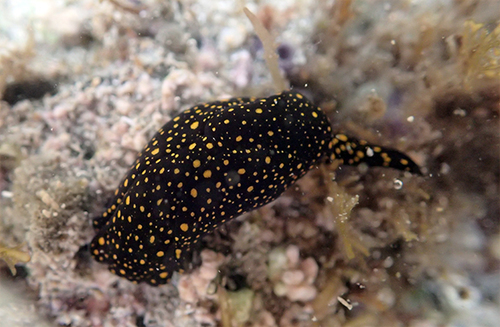
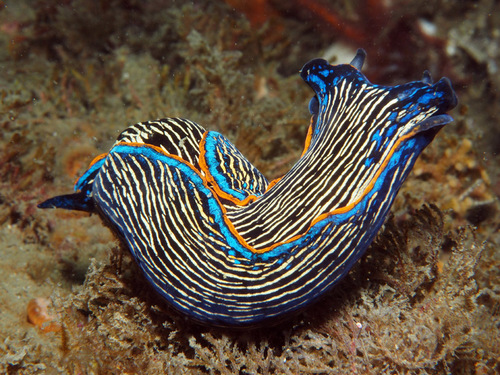
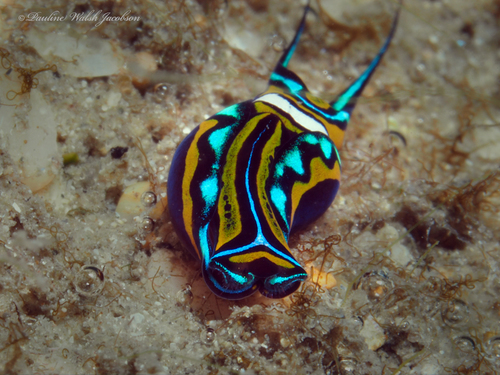
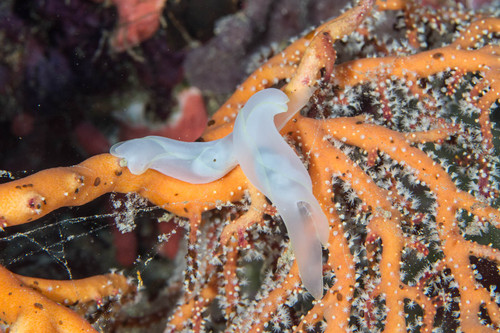
Philinopsis speciosa Pease, 1860 is a large sea slug mollusc that reaches a length of around 125 mm (5 in). It has a well-developed, broad headshield, with a squared front end, a tapering rear that ends in an upright tube, and this headshield is used for gliding over and burrowing beneath sand surfaces. Behind the headshield, it has a body shield that bears two rounded lobes at its back. Lateral outgrowths called parapodia grow on either side of its body. The colouring of this species is very variable; it is usually brown, dark brown or black, marked with white, cream, yellow or orange spots, and has a thin blue line or streaks along its margin. Sometimes there is an extra white or yellow line at the margin, and a pair of longitudinal orangish bands may be present near the midline of the headshield. This species has a widespread distribution across the tropical Indo-Pacific region, with a range that extends from the east coast of Africa and the Red Sea to Japan, Hawaii and New Caledonia. It occurs on the lower shore and in the subtidal zone, on sandy and clay bottoms and among seaweed, at depths down to approximately 20 m (66 ft). Like other members of the family Aglajidae, Philinopsis speciosa is a predator, and its diet consists mostly of other gastropod molluscs. It does not have a radula, but it has a partially eversible pharynx that can suck up and engulf its prey, swallowing it whole. After digesting the soft tissues of its prey, the slug regurgitates any leftover shell or indigestible material. Philinopsis speciosa is a hermaphrodite, and mating groups form either a circle or a short chain. The penis is located on the right side, level with the head, and the female genital opening is on the right side further back along the body. In a mating chain, the first individual acts as a female and receives sperm from the second individual; the second acts as both male and female, providing sperm to the first individual and receiving sperm from the third. The last individual in the chain acts only as a male. The white eggs of this species are wrapped in a thin layer of mucus, and the resulting egg strand is wound around the slug's head in a tangled cylinder. The slug then pulls its head out of the cylinder and sticks the end of the filament to the substrate.