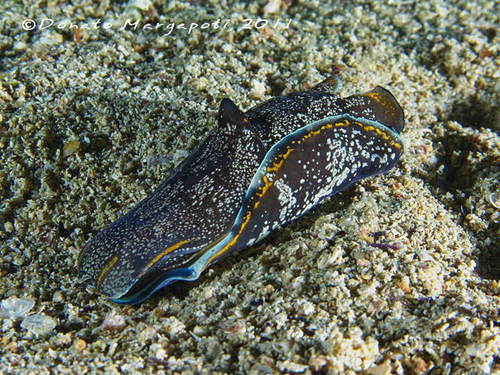
About Philinopsis depicta (Renier, 1807)
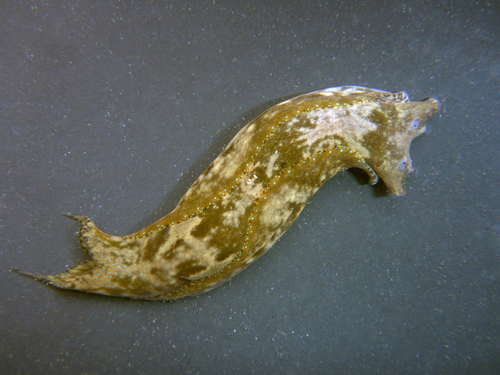
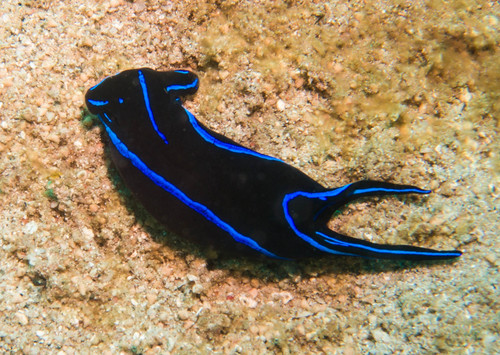
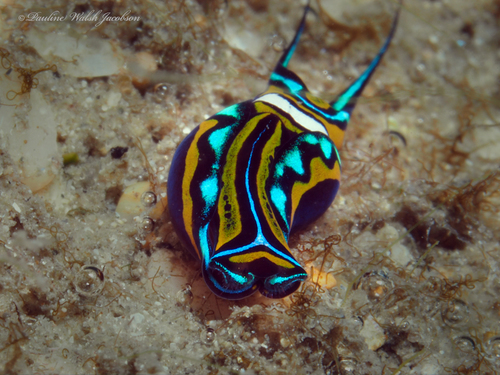
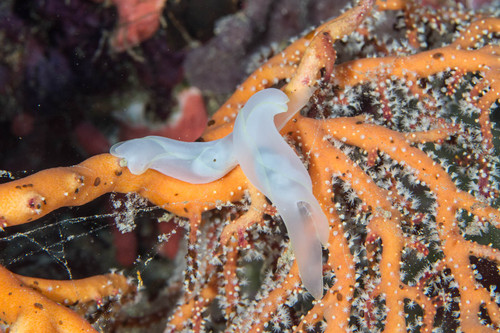
Philinopsis depicta is a large sea slug that can reach a length of 10 cm (4 in). Its head is protected by a large cephalic shield that extends to the central body, where it forms a noticeable pointed protrusion. A pair of parapodia extend from the foot and reach as high as the back. Its small, flattened shell is hidden by the posterior shield, which ends in two small, sometimes raised, lobes. The species' colouring is somewhat variable: individuals may be pale brown with white specks, or a deeper brown to blackish shade, often flecked with small white specks that join together to form small patches. Nearly all individuals have a continuous double line of orange and blue that outlines the cephalic shield, parapodia, posterior shield, and the tip of the mantle. It can be confused with two other sea slug species: Aglaja tricolorata and Melanochlamys wildpretii. Aglaja tricolorata is tan, has more regularly arranged white spots, no peak on the cephalic shield, and no orange and blue lines around its body. Melanochlamys wildpretii has a more uniform orange-brown colour, no peak on the cephalic shield, and a slender white line that outlines the parapodia and crosses the mid-back. Philinopsis depicta is native to the Mediterranean Sea. Reports of it occurring in the Caribbean Sea likely refer to a similar but separate species. It is a shallow-water species found on muddy sand. All sea slugs in the Aglajidae family are predators. The diet of Philinopsis depicta has not been confirmed precisely, but stomach contents have been found to include Bulla striata and Haminoea species. It probably eats other sea slugs, and has been recorded eating Elysia timida in captivity. This species has no jaws, stomach grinding plates, or radula. Researchers think it protrudes its foregut to suck prey in whole, then ejects shells or undigested fragments. Philinopsis depicta is a hermaphrodite. Its gonopore is located under the right parapodium at the rear of the body. In a mating pair, either individual may receive sperm from the other, or both may exchange sperm mutually. An inseminated individual lays eggs embedded in a transparent thread, which is usually covered with sand. After hatching a few days later, the veliger larvae are planktonic for some time, before settling on the seabed and undergoing metamorphosis into juveniles.