About Philesturnus carunculatus rufusater (Lesson, 1828)
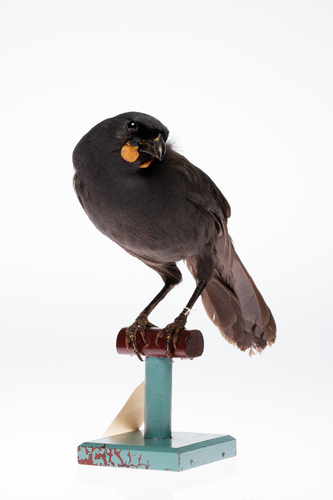
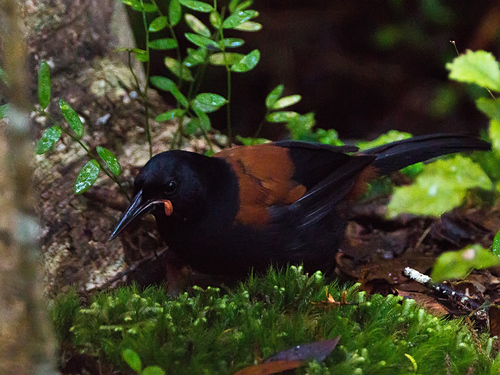
The South Island saddleback, also known by its Māori name tīeke (scientific name Philesturnus carunculatus), is a forest-dwelling passerine bird belonging to the New Zealand wattlebird family. This bird is endemic to the South Island of New Zealand. Historically, the North Island saddleback and the South Island saddleback were previously classified as a single species. The New Zealand Department of Conservation currently lists the South Island saddleback as At Risk—Declining.
In the early 19th century, South Island saddlebacks were widespread across both the South Island and Stewart Island. By the end of that century, however, the species had declined significantly and was approaching extinction, driven by the impact of introduced predators. By 1905, the entire remaining population of South Island saddlebacks was restricted to the South Cape Islands, located off the coast of Stewart Island. In 1962, ship rats were introduced to Big South Cape Island, an event that also caused the extinction of the greater short-tailed bat, Stewart Island snipe, and Stead's bush wren. In early 1964, the New Zealand Wildlife Service translocated 36 remaining South Island saddlebacks from Big South Cape Island to nearby pest-free islands: 21 individuals were moved to Big Island, and 15 were moved to Kaimohu Island. Additional translocation projects and targeted predator removal work allowed the South Island saddleback population to recover. The current total population is estimated at around 2000 individuals.